


If you haven’t read part one of my college football playoff preview, then I would like you to do so. We did a breakdown of the upcoming matchups between #10 Miami vs #2 Ohio State, as well as #5 Oregon vs #4 Texas Tech.
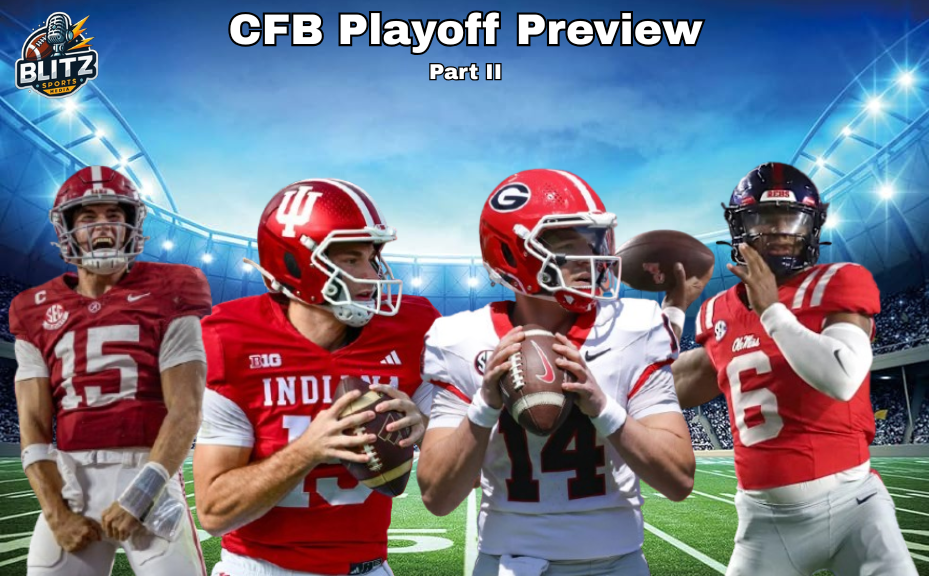
In this one, we’ll be diving into the matchups in the 4 pm and 8 pm time slots on Thursday. The Indiana Hoosiers are looking to prove that new blood will take the crown, while Alabama is looking to say not so fast. Georgia is looking to continue its dominance of the last 5 years, while Ole Miss is trying to prove “no Lane Kiffin, no problem.” Let’s dive in.
#9 Alabama vs. #1 Indiana
Location: The Rose Bowl in Pasadena, CA
Spread: Indiana (-7)

Over/Under: 48
ML: Indiana (-235), Alabama (+200)
Ranked Matchup Performances
Alabama has played five games against opponents currently ranked in the CFP Top 25. Indiana has played three such games. How have these teams fared in those matchups?
Against those five ranked opponents, Alabama is averaging 23.2 points and allowing 22. Against its three ranked opponents, Indiana is averaging 21 and allowing 15.
In these ranked games, Ty Simpson is averaging 277.2 yards, while Fernando Mendoza is averaging 223.3 yards.
Alabama Might Find Rushing Success, Here’s Why
In the previously mentioned ranked games, Alabama RBs are averaging 3.5 YPC, and Indiana RBs are averaging 4.27 YPC. Alabama’s YPC increases in ranked games by 9.4%, while Indiana’s decreases by 19.4%.
Alabama has faced a gauntlet of run defenses unlike any team has ever faced. The Tide has faced 10 defenses that allow less than 4 YPC, and 7 that allow less than 3.5 YPC. The average Alabama P4 opponent allowed 3.26 YPC on the season. How does this stack up to Indiana’s run defense? Well, that requires a little more than face value research.
Indiana allowed 3.1 YPC on the season, but it faced one of the nation’s worst collections of rushing offenses. The Hoosiers faced just four P4 teams ranked inside the Top-75 in relative rushing YPC. In those 4 four games, opposing RBs averaged 4.15 YPC against Indiana. Why is 4.15 YPC significant? Because 4.15 YPC would be the worst P4 run defense that Alabama has faced.
On the season, Alabama is rushing for 11.3% more than its opponent’s average allowed. Why is that a significant number? Well, Georgia, which is regarded as one of the nation’s best rushing attacks, averages -12.87% of its opponent’s average allowed. Alabama has faced seven defenses that allow <3.5 YPC. Georgia has faced just two. Against those defenses, Alabama RBs averaged 3.45 YPC, while Georgia RBs averaged 1.84 YPC.
I’m not saying that Alabama is going to rush for 200 yards on 5 YPC against Indiana. But, Alabama, from a relative perspective, is more successful on the ground than anyone realizes.
Strange Betting Line
Currently, Indiana is favored by 7 points. Why is that strange? Most analysts believe that the actual Vegas line should have Indiana favored by 13 or 14 points.
College Football Nerds, a well-known YouTube channel that covers college football analytics, has a betting model that projects Indiana to be a 13.3-point favorite.
In FEI, a popular power rating metric, Indiana has an FEI of 1.74, while Alabama’s is 1.12. That 0.62-point gap is the same size as the gap between Alabama and Florida State. Why is that significant? Alabama was exactly a 13.5-point favorite over Florida State.
The betting line on this game has many analysts puzzled. The seven-point spread is widely believed to be incorrect. These two teams are in different echelons in terms of power ratings. So, why is the betting line only seven points?
Score Prediction
Alabama: 31
Indiana: 17
#6 Ole Miss vs. #3 Georgia
Location: Caesar’s Superdome in New Orleans, LA
Spread: Georgia (-6.5)
Over/Under: 56
ML: Georgia (-230), Ole Miss (+195)
The Run Game
When I look at this game, I see a clear path for Georgia to get 40 points and dominate time of possession. Ole Miss cannot stop the run and cannot get off the field.
Ole Miss is #55 in yards per play allowed, #84 in yards per carry allowed, #70 in rushing yards per game allowed, #47 in 3rd down conversion rate allowed, #100 in redzone scoring allowed, #91 in takeaways per game, and #77 in defensive penalties per game.
Meanwhile, Georgia is #30 in 3rd-down conversion rate, #1 in 4th-down conversion rate, #14 in red-zone scoring rate, #31 in rushing yards per game, #13 in giveaways per game, and #4 in time of possession. Georgia averages 41.5 rushing attempts per game. If your defense cannot stop the run, then Georgia will run the ball 40-50 times.
I stated earlier that Georgia actually gets -12.87% of opponents’ YPC averages. That’s not great. But, considering Ole Miss allows 4.6 YPC, that means Georgia can still get 4+ YPC in this game. If you want to slow down Georgia’s offense, you have to keep Georgia below the 3.5 YPC range.
Earlier in the season, Georgia ran the ball 49 times against Ole Miss. The Dawgs totaled 221 yards on the ground.
Ole Miss’s Path to Victory
Now that we’ve covered how Georgia will attack Ole Miss, how will Ole Miss attack Georgia? The answer is through the air.
The Georgia pass defense ranks #37 in completion percentage allowed, #28 in yards per pass allowed, #47 in pass yards per game allowed, #88 in interception rate, #117 in sack rate, and #106 in takeaways per game. This is a defense that has struggled to sack the quarterback for the majority of the season.
Ole Miss’s offense ranks #7 in yards per pass, #4 in pass yards per game, #10 in sack rate allowed, and #22 in giveaways per game. QB Trinidad Chambliss has thrown just 3 INTs across 362 pass attempts.
Trinidad Chambliss has proven himself to be one of college football’s best players. Had he started the first two games of the season, Chambliss would likely have pushed for 4,000 passing yards.
Multiple Injuries to Monitor
Ole Miss TE Dae’Quan Wright is reportedly dealing with a rotator cuff injury.
Ole Miss RB Kewan Lacy reportedly suffered a shoulder/collarbone injury in the playoff game against Tulane. Lacy is one of college football’s most productive backs, though Georgia is likely to shut him down. Lacy ran for 2.6 YPC in the previous matchup. Georgia is one of college football’s most physical defenses, so we will be monitoring Lacy’s pain tolerance.
Georgia DE Gabe Harris Jr will miss this game with a turf toe injury. Harris is questionable for the remaining playoff games should Georgia win this one. Harris has 26 tackles and 6.5 TFLs on the season. At 6’4 270 pounds, his physical presence will be missed.
The Ultimate Wildcard
Despite Ole Miss’s elite offensive personnel, there is one factor that doesn’t involve personnel on the field. I cannot ignore the fact that Lane Kiffin is no longer here for Ole Miss.
Charlie Weis Jr. will be the play-caller for Ole Miss. Weis Jr. served as the “offensive coordinator” under Lane Kiffin, though Kiffin served as the play-caller. Kiffin might be college football’s best play-caller.
Kiffin’s knowledge of modern defenses is irreplaceable. His ability to identify schemes, patterns, and formations in real time is what sets him apart.
As the game goes into the 3rd and 4th quarters, Kirby Smart and Glenn Schumann are famous for tightening their defensive hold. They will no longer be battling Lane Kiffin. I cannot see Ole Miss matching their previous offensive performance against the Dawgs without Kiffin.
Score Prediction
Georgia: 38
Ole Miss: 24