

Picking the best value players in Fantasy Baseball is hard, honestly, sometimes too hard. However, avoiding blatantly good players in the draft is even harder. When all signs point to players being exceptional, maybe we should just acknowledge that they are?
In spite of that, Fantasy Managers, and I included, love to find out if these players are truly exceptional in relation to their draft price. Once we complete this analysis, we find players who appear overpriced; those players are often labelled fades, avoids, or worst, a bust.
Fantasy baseball fades are players that managers would prefer not to draft, although sometimes drafting them might make sense in certain circumstances. Avoids are players that fantasy baseball managers refuse to draft, and won’t even think about it. Busts are players who flat out fail, maybe a combination of some of the fades and avoids, but things go extremely wrong. Some recent examples would be the 2025 seasons of players like Yordan Alvarez, Jackson Merrill, Devin Williams, and Sandy Alcantara.
One thing we need to understand is why this happens in the first place. How come obviously good players can be outcast as potential failures for fantasy baseball?
Well, this happens because prices get inflated to predict or reflect a player’s best-case scenario outcome. When a player is drafted near their absolute ceiling, the margin for error becomes incredibly small. Even a solid season can suddenly feel like a disappointment when it doesn’t justify the draft cost. Avoiding those potential disappointments is a big key to winning your fantasy baseball championship.
With that in mind, here are some players who stand out as fade candidates in 2026 fantasy baseball drafts.
Cal Raleigh – ADP #15
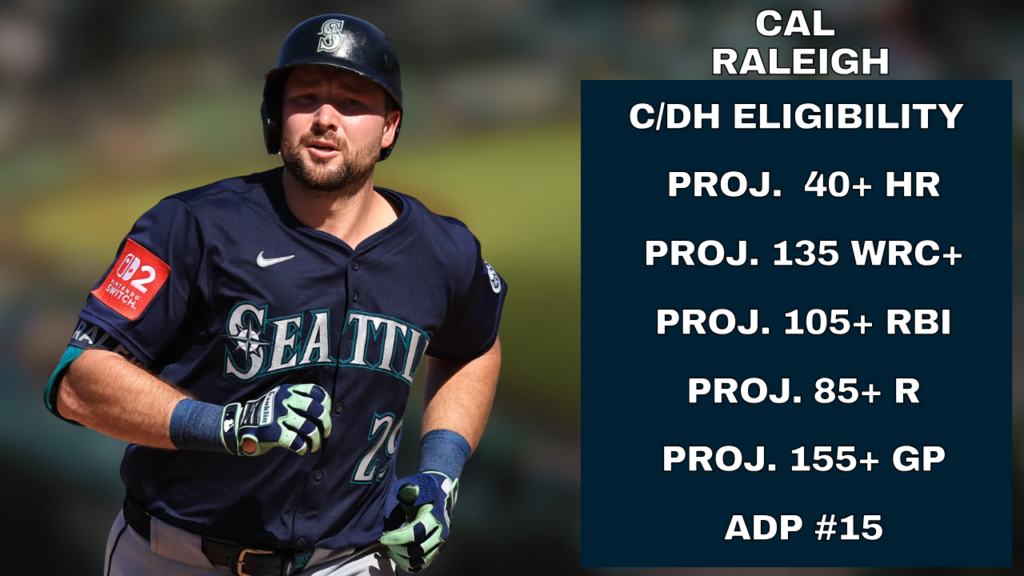
You might be wondering why, after one of the most historic offensive seasons in MLB history, especially for a catcher, Cal Raleigh, makes the fade list. Well, the Seattle Mariners catcher is making this list due to his heightened cost and future regression.
Cal’s 60 home runs in 2026 were extraordinary, but projections suggest it was not supposed to happen. His 60 home runs last year were the most in a season for a catcher in MLB history. His complete stat line in 2026 was 60 HR, 110 R, 125 RBI, and slashed for a decent .247/.359/.589. That has placed him very high in this year’s draft stock; he currently has a consensus ADP of 15 and is by far the highest ranked catcher.
His ADP of 15 screams that he is being overprojected by the fantasy community and makes him far overpriced. Firstly, we almost never see players repeat historic seasons like Cal’s 2025, and it becomes even more difficult to do so as a catcher.
For more context on the type of player Cal really is, we can look at the three full years of data prior to his 2025 season. In his 2022-2024 seasons, Cal averaged 30 HR, 65 R, 80 RBI while slashing .221/.300/460. To me, this shows a clear gap in the way people are drafting Cal compared to the player he has been in the last couple of years.
This season, Cal’s projections have dwindled down quite a lot, telling us just how much of an outlier season he had. In 2026, he is projected for 40 HR, 85 R, 105 RBI while slashing approximately .235/.330/500.
The one major thing I love about Cal, and that needs to be discussed, is the hitting profile. For context, Cal had the single highest average launch angle in the MLB, batting balls on average 25.2° into the air. This places him the highest by a full 2.1° above the Detroit Tigers’ Spencer Torkelson, another player who had a career year. This essentially means, that Cal is launching balls the highest in the MLB, which can help translate to home runs. So, it’s not all bad with Cal’s outlook, it’s the other stuff that’s pushing him down.
Another major reason is his overall offering of categories/points. At an ADP of 15, drafting a catcher that high is a major risk. Catchers are already poor multi-category contributors compared to other positions. For Cal, it gets an even worse outlook in points leagues where his home run dependent hitting starts to pile on.
If you look at the rankings, there are a multitude of players in that range that managers should look to draft over Cal. Players who will give more counting stats, better slash lines, and oh yeah… stolen bases.
In the range where Cal is going, you can instead take players like Fernando Tatis Jr. (ADP #14) , Jackson Chourio (ADP #22), Corbin Carroll (ADP 17), Junior Caminero (ADP #18), and honestly, many more that provide more balanced category-stuffing abilities.
All things considered, we can look for a major regression in Cal’s offensive contribution. Leading me to believe his current ADP of 15 is extremely overpriced. Projections agree with this distinction as well. Notably, Cal Raleigh is also just not a multi-category contributor like some of the other players in this draft range. Drafting Cal this early in drafts is simply killing chances of winning your leagues. I think we all agree that watching his 2025 season was incredible, but don’t let that trick you into drafting him in 2026.
Nick Kurtz – ADP #20
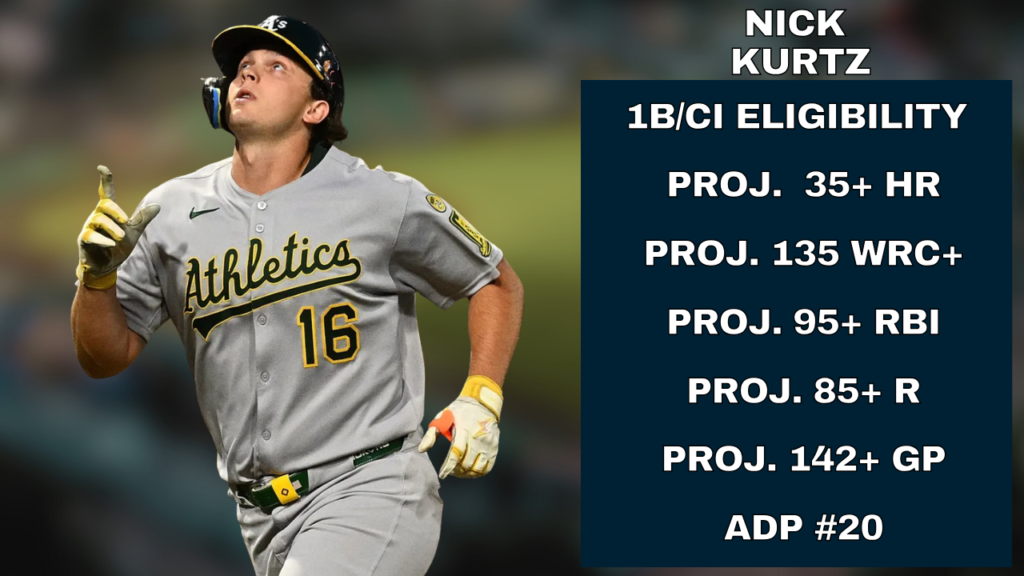
Similar to Cal Raleigh, 2026 was also the year of Athletics slugger Nick Kurtz. He had one of the most historic rookie seasons ever. A player who most likely went undrafted in typical leagues ended up returning absolutely insane value. For reference, last year, Nick Kurtz had a preseason ADP of more than 400. His rookie explosion was quite literally out of this world.
Now, Nick Kurtz has skyrocketed draft boards and finds himself with a consensus ADP of 20. This makes him one of the biggest jumps in fantasy baseball history. This, along with the strength of the first base position and other players in his draft range, leads Nick Kurtz to be on the fade list.
His 2025 season saw him hit the 8th most home runs in a rookie campaign with 36, and the most since Pete Alonso had 53 of them in 2019. His 2025 season was sensational, he put up a monstrous 36 HR, 90 R, 86 RBI and slashed a phenomenal .290/.383/.619. This also only came in the form of 117 games and just shy of 500 plate appearances. On all accounts, Nick Kurtz stunned the MLB in 2025 and cemented himself as a premier power hitter.
This production was sneakily deceiving. One of the more beautiful things about baseball is expected stats, which look at underlying data to more accurately find out a player’s true statistical outputs. The biggest outlier for Kurtz was his batting average of .290, which, when we turn to his xBA or expected batting average, is actually .249. This is notably one of the more significant drops in xBA vs BA in qualified batters. This leads me to believe even more so that his 2025 statistics were fairly irregular. However, projections do suggest he will have increased power output and project 35-40 home runs, which seems more than plausible.
At an ADP of #20, like Raleigh, Nick Kurtz is only a partial category filler with potential strikeout issues. He’ll slug excellently and put up really nice runs and RBIs. However, he’s virtually a zero in steals and pretty underwhelming for average. Nick Kurtz’s stock is also hurt by the plethora of excellent first baseman in his range, and later in drafts, who can offer similar utility.
The two standout competitors to Kurtz are Toronto Blue Jays Vladimir Guerrero Jr. and newly signed Baltimore Orioles Pete Alonso. Who have consensus ADPs of 19 and 25, respectively. I would much prefer the consistency and historical guarantee of success that the two of those players provide over Kurtz.
I understand the perspective of buying in on Nick Kurtz’ ceiling, but I think that’s an easy way to lose out on sustainable production if it goes awry. Although these players provide slight differences, Kurtz is still a much higher risk and less proven. Some other cheaper and similar options at first base include names like Bryce Harper (ADP #38), Matt Olson (ADP #37), and Rafael Devers (ADP #41) . These names are all proven players in the major leagues with extensive data to back their production.
In conclusion, I love Nick Kurtz as a player, but I am really disinterested in him at his cost at an ADP of 20. I think that his draft rank is more focused on his potential upside, rather than his realistic outcomes. With the 20th pick, there is a great selection of players who will provide more category production, cost less, and are much more proven. Also, if for some reason you truly desire a first baseman in this range, you can simply draft Vladdy or Pete Alonso, or wait and draft a more than serviceable option later on.
James Wood – ADP #32
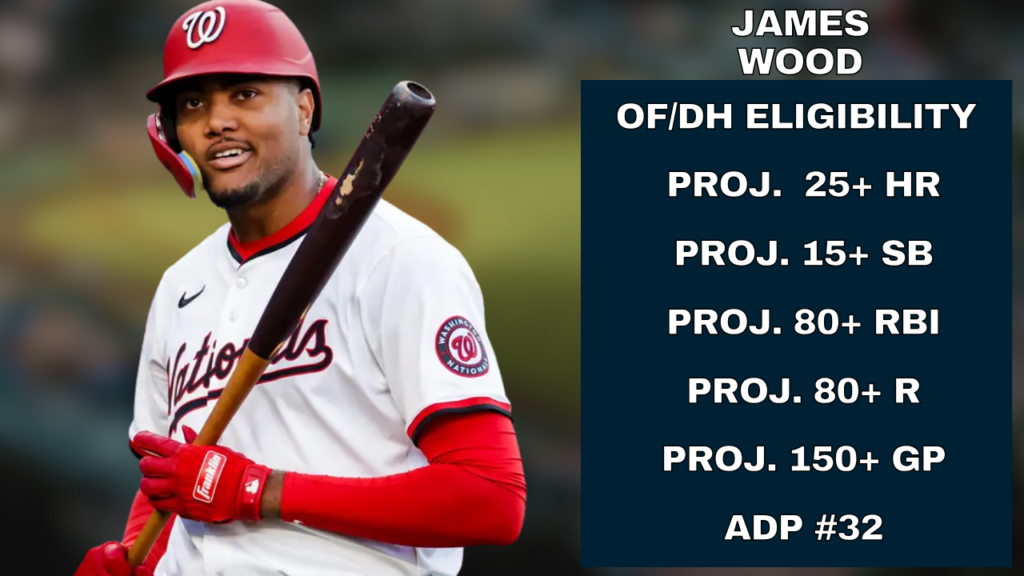
Washington Nationals outfielder James Wood had one of the most lopsided seasons in recent memory. His 2025 season was the definition of hot and cold. In the first half of 2025, James Wood was an ascendant superstar putting up a 150 wRC+ while smashing 24 HR. In the second half of 2025, he was a strikeout machine with a 93 wRC+ and only gave us 7 HR. His batting average also crashed from .278 to .223, and he finished the season slashing .256/.350/.475.
The difference in his season splits was absurd; his inconsistency rendered him a borderline negative asset in the second half of fantasy baseball leagues, and is why he finds himself on the fades list.
James Wood’s ADP of 32 definitely has his potential baked into it, and fairly so. In theory, if we see him do anything remotely similar to his first half production, he’ll be one of the league’s best hitters. On the contrary, if we see this inconsistency, or the back half of his season comes into action again, he’ll be borderline unplayable in fantasy leagues.
On top of his wildly inconsistent second half of 2025, James Wood led all batters in strikeouts with 221. He also led the entire league in strikeout percentage at 32.1%, but his second half saw that increase to an inflated 39%.
James Wood is the typical three true outcome batter. When he’s up at the plate, he’s either going to hit a bomb, get a walk, or strike out. The bad part about this is that when he’s struggling, it leaves so many holes in his production. If we take a similar player like Kyle Schwarber, at least he actually accumulates extensive home run production. With James Wood, his projections already predict an underwhelming 25 home runs, which you can acquire in droves much later in the draft.
The worst part about James Wood’s outlook is the clear contrast when we start comparing him to other players in his draft range, or the worst part, when we compare him to outfielders well beyond his ADP. My favorite comparison when looking at projection data is how he directly compares to Philadelphia Phillies slugger Adolis Garcia. Let’s take a look at exactly how their projections fare for 2026.

- James Wood – Consensus ADP 32 – Projections: 25 HR, 15 SB, 80 R, 80 RBI, .255 AVG
- Adolis Garcia – Consensus ADP 225 – Projections: 25 HR, 12 SB, 70 R, 75 RBI, .240 AVG
To me, this is where I start to get really scared of James Wood. Under no circumstances can I draft someone who is going to put up eerily similar projections to a player with an ADP of 225. For what it’s worth, this comparison works with other outfielders too, not just Adolis Garcia. Also, I understand the potential that James Wood possesses, but that potential is what is meteorically increasing his cost.
So, for me, James Wood is a definitive fade, and I will not be drafting him. If he comes out and plays like first-half James Wood, I’ll gladly take this poor take on the chin.
Corey Seager – ADP #86
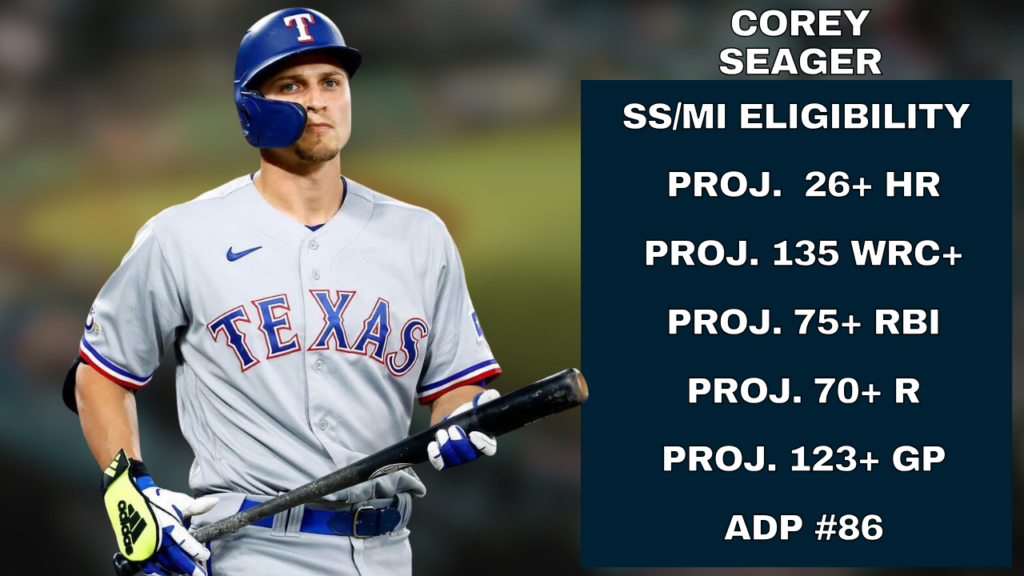
Before I begin, I just want to say that Corey Seager has been one of my favorite players to watch in the MLB for a while now, and it pains me to list him as a fade. I think Corey Seager is awesome, and arguably the best pure-hitting shortstop in the entire league. Regardless of my personal opinions, there are some glaring historical issues we need to address.
Right now, Seager’s consensus ADP is 86. This places him as the 10th overall shortstop. In a vacuum, you could actually argue he’s being undervalued. Last year, he had an excellent 102-game season, where he put up 21 HR, 61 R, 50 RBI, while slashing a solid .271/.373/.487 with a 138 wRC+. Again, I reiterate that he put those numbers up in 102 games.
That sample is awesome, but then we remember we lost 60 games’ worth of production. Then we compound the fact that Corey Seager habitually misses games due to injury. In his last 7 seasons, Corey has missed an average of 48 games, which is roughly 30% of the entire season every year.
His greatest weakness is his inability to stay healthy. Compared to other suitable offensive contributors in that range, his lack of health becomes a glaring issue. Other options around that price, like Chicago Cubs Seiya Suzuki or Seattle Mariners Randy Arozarena, are much better and healthier selections. For context, those two players come with consensus ADPs of 85 and 83 respectively.
Drafting Corey also means you essentially need to draft a backup shortstop, or some sort of utility type player, to fill the gap he eventually leaves. If you don’t draft a backup shortstop or have no ideal replacements on the waiver wire, your season can easily become compromised.
In fantasy baseball, availability is the best ability. It’s why we typically see the healthiest players have the highest valuations. My reasoning for fading Corey Seager is to simply avoid the headaches that he brings. Trying to find a replacement-level option, especially in deeper leagues, is dreadful. If you can avoid it altogether, I highly recommend it. Drafting players who are consistently available all season long is one of the best ways to help win your fantasy leagues. If you draft Corey Seager, you’re voluntarily doing the opposite of that.
Trey Yesavage – ADP #126
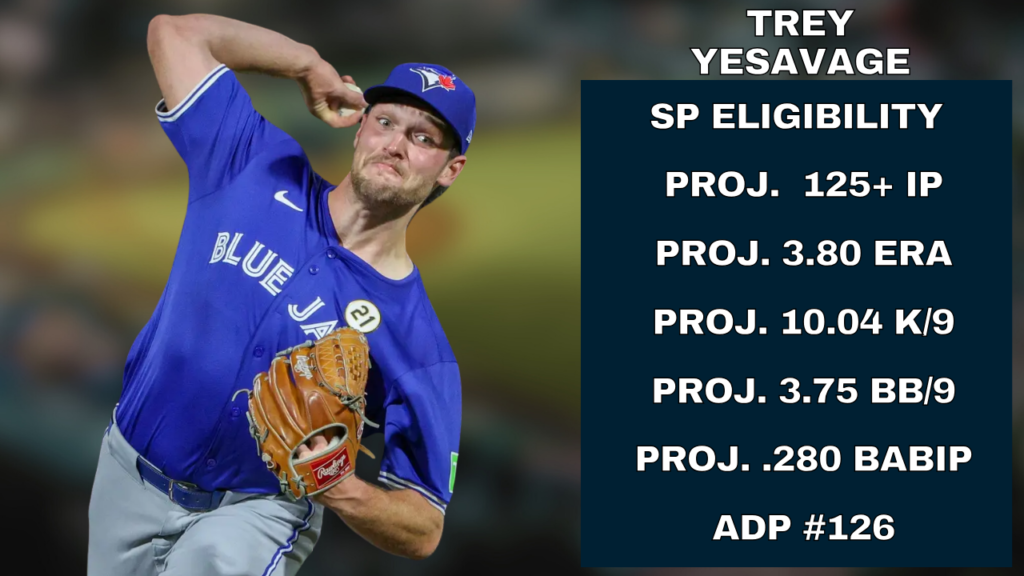
Our pitcher fade comes in the form of Toronto Blue Jays postseason phenom Trey Yesavage. As a Toronto Blue Jays fan, this hurts me, but maybe gives you even more incentive to fade him with me. For Yesavage, all the offseason signals have been extremely discouraging and odd.
He barely ramped up at all in the offseason, and the Blue Jays are being very cautious with him. This is also partially due to his 2025 workload, and the Blue Jays new and improved pitching staff. This offseason, the Blue Jays signed several notable free agent pitchers this offseason, including names like Dylan Cease, Cody Ponce, and Max Scherzer and more. Reports suggest the Blue Jays may be running with a 6-man rotation to start the year.
So far, the general belief around Trey Yesavage is that he will be on a heavily restricted pitch and innings to start the season. Reporters are suggesting the Blue Jays will only allow his starts to go 3-4 innings at most. The Blue Jays have yet to give us a timeline for when Yesavage plans to be a full go, meaning fantasy managers could be waiting a long time until Yesavage will be pitching full 6+ inning starts.
The Blue Jays are approaching this caution because of his 139.2 innings pitched across all competitions. It’s no secret that Yesavage threw the ball a ton last year, and it’s no secret that his arsenal is incredible. Arguably the most promising in the entire league with postseason success to show for it.
To remind everyone, in Game 5 of the World Series, Trey Yesavage delivered a historic 12-strikeout game allowing only one run in 7 innings and walked none. Doing that in the World Series is one thing; doing that against the Los Angeles Dodgers superteam in the World Series is even more insane. Also, he was a rookie…
Yesavage has an immense pitching profile and more-than-serviceable arsenal. His main pitches are his 4-seamer, slider, and split finger. These are all extremely deceptive due to his release height being over 7 feet. His pitches come down from the mound very uniquely, and create an illusion as if they are faster than their actual clocked speeds.
This fade is because of the true fantasy value he will possess over the course of the season. Sure, he’s an amazing pitcher, but for someone to lag into the season, and also only be projected for 125 innings, it’s far too pricey for an ADP of 126. In that range, you can draft other respectable pitching options like Cam Schlittler, Ranger Suarez, or even Bubba Chandler. Who are all slightly more discounted than Yesavage and will get ample opportunity. For me, Trey Yesavage is a definite but painful fade for 2026.
Final Thoughts & Draft Considerations
Now that we’ve discussed the potential fades for this fantasy season, let’s quickly recap.
- Cal Raleigh – ADP 15 – Large regression incoming, overpriced and limited category contributor, strikeout and batting average concerns as well. Instead, target true multi-category monsters in this range of the draft, and pick up a more fair-priced catcher later on.
- Nick Kurtz – ADP 20 – Price based on absolute ceiling level production. 1-year sample size, but projections and xBA suggest he is an elite power hitter. The overall price is wildly inflated. Vladdy and Pete Alonso are exceptional and proven first basemen who will provide more or equal value with less risk, and other multi-category players are also viable options at this range.
- James Wood – ADP 32 – Insanely unbalanced production in 1st half vs. 2nd half of season. His price is also based on the absolute ceiling level production. The inconsistent second half leaves so many questions surrounding his abilities. There are many more cost-effective options for the type of return he will give. Play it safe and draft a more proven and sure-fire player in this range of the draft.
- Corey Seager – ADP 86 – Arguably the best-hitting shortstop when healthy, but he is never healthy. Has missed an average of 30% of games in the last 7 seasons. There are more risk-free and cost-effective options in this range in the draft. Either take a higher level shortstop, or one of the cheaper options with less health risks.
- Trey Yesavage – ADP 126 – Complete confusion and chaos surrounding his 2026 season outlook. Blue Jays are limiting his availability in the early-to-mid season starts to 3-4 innings. Blue Jays also have a potential 6-man rotation, which spreads him even thinner. Target pitchers with more projected innings or better starting potential. Unnecessary risk to draft a player who may not contribute for the first 3 months of the season. During the season, he’ll be a nice buy-low option if you time it before his workload changes.
Understanding which players might not return the most value, or might fall flat, is crucial to a fantasy baseball manager’s success. Last year, we had a dozen players fall completely flat, leaving managers scrambling to find replacements of meaningful production. In my experience, managers who can avoid the players who fall flat are the ones who most commonly succeed. Based on several factors, I think the players mentioned above are poor selections for their cost, and consider them a fade or blatant avoid. To me, they are some of the clearer candidates for this label.
Follow me on X for more daily fantasy baseball analysis, strategy, and player valuations! @DiogoSantos_HQ