


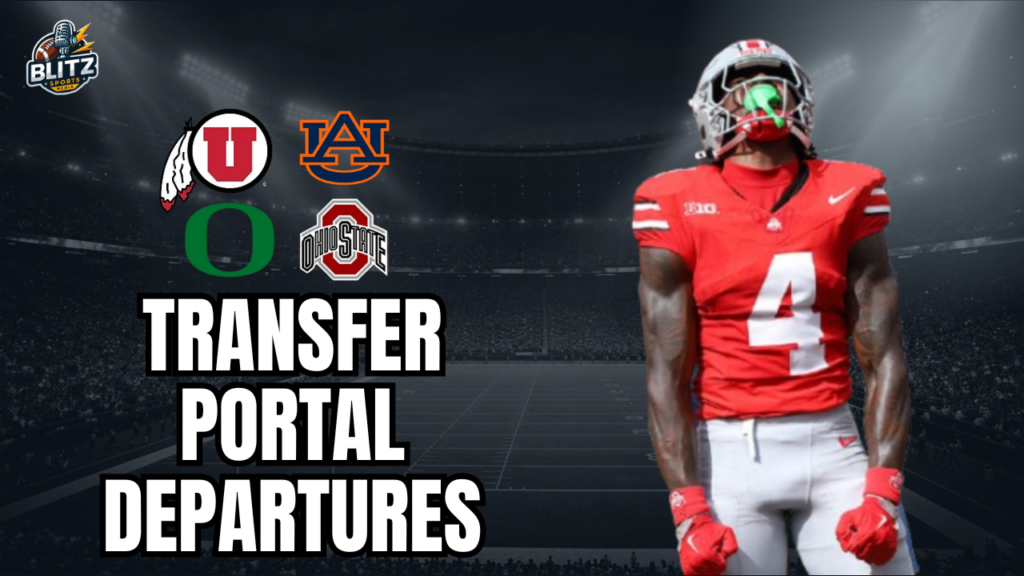
The transfer portal gives, and the transfer portal takes. While it’s generally smaller college football programs that endure the most damage from portal departures, the big programs suffer losses as well. For instance, programs such as Ohio State, Oregon, Auburn, Utah, and Mississippi State all experienced significant losses in certain position groups. Let’s talk about these position groups and how these losses will affect these teams moving into 2026.
Ohio State, WR
The Buckeyes faced an exodus at the wide receiver position following the departure of Brian Hartline, college football’s best wide receiver coach. Former top 100 recruit and 4-star transfer Mylan Graham left for Notre Dame. Former 5-star recruit and 4-star transfer Quincy Porter left for Notre Dame. With the departure of Carnell Tate, both Graham and Porter would’ve battled for the WR2 role, while the loser would’ve battled for the WR3 role.
Ohio State replaced these players with incoming 3-star transfers Kyle Parker and Devin McCuin. Parker is coming off a 300-yard season with LSU. McCuin was a 700-yard receiver with UTSA, though his jump in competition will be substantial.
Ohio State managed to hold on to Brandon Inniss, who is now favored to win the WR2 job. But the Buckeyes will likely be heavily reliant on true freshman Chris Henry Jr. While the wide receiver room still features Jeremiah Smith, this is nothing close to the WR room that Ohio State usually assembles.

Auburn, WR
The transfer portal destroyed Auburn’s roster, as the Tigers experienced one of the largest talent exoduses in college football. In total, 36 players transferred out of Auburn, including six wide receivers.
5-star Cam Coleman, 4-star Malcolm Simmons, 4-star Eric Singleton Jr, 3-star Horatio Fields, 3-star Perry Thompson, and 3-star Cam’Ron King will all play for new teams in 2026. This is perhaps the most crippled wide receiver room in college football since the start of the offseason. Many of these receivers struggled to thrive in Hugh Freeze’s RPO system, and they didn’t want to play in a wide-choice offense run by new head coach Alex Golesh.
Filling in the starting roles will be Chas Nimrod, Keshaun Singleton, and Jeremiah Koger, all three transferring in from South Florida, with Alex Golesh. This wide receiver room went from star-studded to mediocre overnight.
Oregon, DL
During the 2025 season, few position groups in college football contained as much talent as Oregon’s defensive line. The 1’s and 2’s were littered with NFL talent. While Matayo Uiagalelei and A’Mauri Washington remain, much of the talent behind them has transferred out.
3-star transfer Terrance Green went to Alabama. 3-star Jericho Johnson went to California. 3-star Xadavien Sims went to Arkansas. 3-star Tobi Haastrup went to West Virginia. 3-star Blake Purchase went to Ole Miss. 3-star Ashton Porter went to Houston, and 3-star Tionne Gray went to Notre Dame. All 7 of these players were blue-chip recruits out of high school.
Thanks to its massive NIL budget, Oregon was able to retain its group of NFL-caliber draft-eligible starters. However, the depth behind these players took a massive hit. When you lose 7 blue-chip players, performance late in the game and late in the season can drop.
Utah, DL
Due to the departure of head coach Kyle Whittingham, the Utes lost quite a bit of talent, including three contributors on the defensive line, including superstar DE John Henry Daley. Joining Henry Daley in the transfer portal were Jonah Lea’ea and Dallas Vakalahi.
In total, Utah is losing 97 tackles, 22.5 TFLs, and 12.5 sacks. These three pieces on the defensive line helped lead Utah’s defense to rankings of #16 in PPG allowed, #13 in PPP allowed, #1 in opponent completion % allowed, and #10 in yards per pass allowed.
Utah will fill the void with a few transfers, only one of which has a lot of experience. It will also return a few players from its 2025 DL depth, only one of whom brings impactful numbers. New head coach and former defensive coordinator Morgan Scalley would’ve liked to bring back these players for his first year, but the transfer portal had other plans.
Mississippi State, OL
The transfer portal is what creates an impossible situation for a coach like Jeff Lebby. Mississippi State already has an incredibly low NIL budget compared to the rest of its conference, so it can’t recruit the best of the best. But even when Lebby finds a few diamonds in the rough, teams will take those players in the transfer portal the following offseason.
Jayvin James, Zack Owens, and Jimothy Lewis combined to make 26 starts for the Bulldogs in 2025. Their unique athleticism on the offensive line allowed Jeff Lebby to run a unique system of QB power and wide zone. Unfortunately for Lebby, James left for Alabama, Owens left for Missouri, and Lewis left for California.
Losing 3 starters to other schools is common. But for Mississippi State in the current college football landscape, it’s going to be challenging. All three of these players were supposed to return in 2026 and provide Lebby with an advantage along his OL. Instead, Lebby needed to rebuild his OL through the portal.