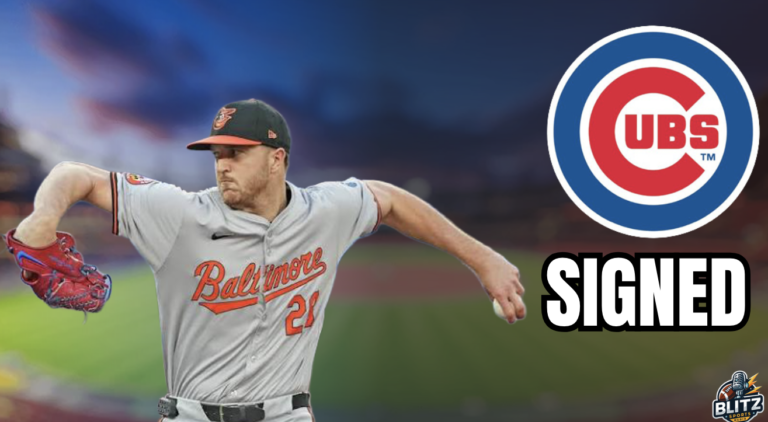


After years of problems in their starting rotation, the Baltimore Orioles are trying to fix the issue by signing Freddy Peralta to a five-year deal worth $125 million. It is the largest contract the Orioles have ever given a pitcher and is the third-largest contract in team history. Only Pete Alonso and Chris Davis have received larger deals from the Orioles than Peralta. It is clear that they are serious about finally solving their rotation issue. They are finally putting the resources into an area that has held them back for years. But is Peralta the pitcher that can end all of these problems?
Can the Orioles Trust Freddy Peralta As Their Ace?
In 169 innings last season, he pitched to a 4.42 ERA with 156 strikeouts to 63 walks, a 1.325 WHIP, and a 93 ERA+. But these numbers don’t tell the full story, as most of his struggles came with the New York Mets. With the Mets, he had a 4.99 ERA over 113 2/3 innings, a 1.478 WHIP, and an ERA+ of 81. After he was traded to the Tampa Bay Rays, his numbers got better. In 55 1/3 innings with the Rays, he had a 3.25 ERA, a 1.012 WHIP, and a 131 ERA+. He also had a fantastic postseason, being named ALCS MVP.
While the numbers were much better with the Rays, it is worth noting that this was largely due to luck. A quick look at his postseason performance shows this. Even during some of his most dominant performances, he had to work himself out of jams and put a lot of guys on base. His underlying metrics also show this. His FIP was 3.93 with the Rays, nearly three-quarters of a run higher than his ERA. This means that, on the things he could control, his ERA should have been higher.
Throughout his time in he majors, Peralta has relied heavily on his four-seam fastball. Last season, he threw it 53% of the time, and it sits around 95 mph. He complements it with a changeup, which he throws 23.4% of the time. It was his most effective pitch, producing an opposing batting average of .224. He also has a curveball that produced a 30.8% whiff rate, the best of the three pitches. He has also tried to add a sweeper, slow curve, and slider to his arsenal, but throws them less than 6% of the time.

The Orioles hope that this arsenal can produce the results we saw in the second half of 2026 and the 2025 season. But given Peralta’s track record, it is worth it. When he was with the Brewers, he was considered to be one of the better pitchers in baseball. He has consistently posted an ERA in the mid-threes and has struck out more than 200 batters in the three seasons before this one. Doing that for an extended period makes it seem like his struggles with the Mets were nothing more than an outlier.
Of course, Orioles fans have reasons to be concerned. The biggest is that Peralta’s fastball plays much better in domed stadiums. In domed stadiums, his fastball has held opponents to a .198 batting average and a .378 slugging percentage. But in outdoor stadiums, these numbers jump to a .250 opponents’ batting average and a .401 slugging percentage. In an outdoor, hitter-friendly park like Camden Yards, this could spell doom for Peralta. We could see his struggles return and be worse than they were in New York.
This move is a bit of a boom-or-bust for the Orioles. If it works out, they will finally have the ace they have been missing for years. But if it does not, it will be yet another example of a bad contract they have given out.