


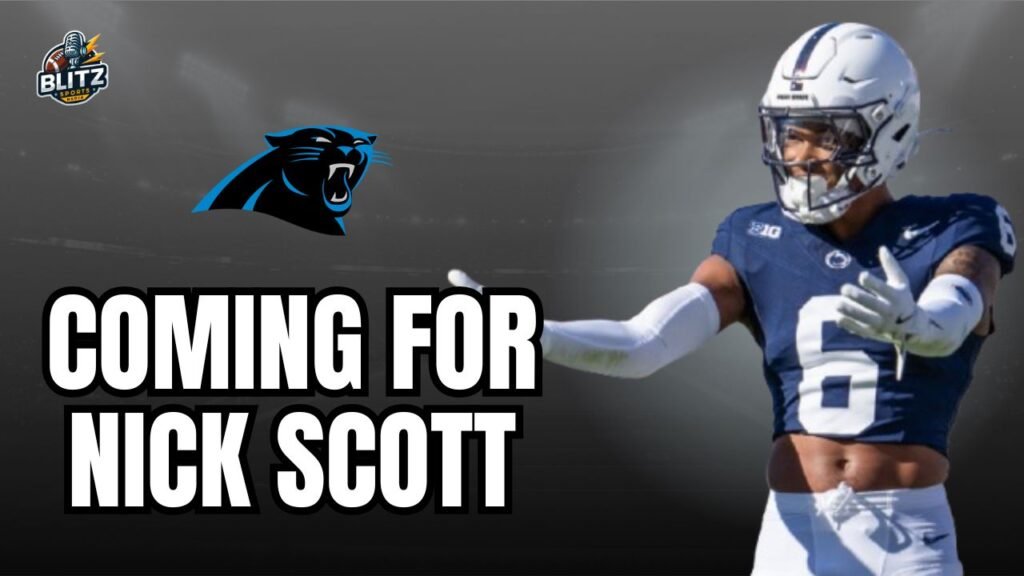
It is a familiar springtime narrative that plays out in NFL facilities across the country. A seasoned veteran, entrenched on the depth chart, gets word that a younger, intriguing prospect has been drafted into his position group. For the Carolina Panthers in 2026, the names at the heart of this narrative are Nick Scott and rookie fifth-round pick S Zakee Wheatley. While Scott is coming off a career year and is the presumed starter, the statistical profile and scouting reports on Wheatley suggest the Panthers may have landed far more than a developmental special teamer with the 151st overall pick; they may have found their future at free safety.
The foundation of the case for Wheatley begins with his final collegiate performance metrics at Penn State. In an era where Pro Football Focus grades have become a critical benchmark for player evaluation, Wheatley’s 2025 numbers are hard to dismiss. He earned an 85.9 overall PFF defensive grade, which ranked him 26th among 914 qualified safeties at the FBS level. This figure places him in elite company. To contextualize, Wheatley’s grade was superior to that of several established NFL starters currently in the league when they were preparing for their own drafts.
His overall grade was built on the back of consistent, dual-threat performance. In pass coverage, Wheatley posted an 83.5 PFF coverage grade, which ranked 62nd nationally. When the ball was thrown into his area, he allowed a passer rating of just 69.2 and surrendered an average of only 5.1 yards per reception. These are lockdown coverage numbers. Importantly, his game was not one-dimensional. His run-defense grade stood at 82.7, good for 69th among all safeties, proving he was not a coverage-first player who shied away from contact.
Scouting reports from the pre-draft process corroborate the statistical evidence of a player with high-level instincts. NFL.com’s Lance Zierlein, a respected voice in prospect evaluation, highlighted Wheatley’s consistent growth. “Wheatley is a long, athletic safety whose career arc shows steady development,” Zierlein wrote. “He played with better decisiveness and route recognition from man and zone looks in 2025. He’s rangy with the ability to play over the top or close quickly to limit run-after-catch.” This development arc was further demonstrated by his PFF run-defense grade, which represented a significant leap from his earlier seasons.

Wheatley’s football character and versatility also emerge as key themes in scouting reports. Despite being a safety at Penn State, his journey began as a cornerback when he first arrived on campus. This background in man-to-man coverage is evident in his ability to hold up in space. “It shows I’m a versatile player,” Wheatley stated before the draft. “Starting at corner, playing post safety, and then this last year going in the box, blitzing and playing the run.”
While he is an instinctive player who is consistently around the football, scouting evaluations do note areas for growth. His deep safety range and ball skills are obvious strengths, but reports from sources like Athlon Sports mention that he can be “a bit stiff in his transitions when trying to match shifty wide receivers in the slot” and that his tackling technique requires refinement. Nevertheless, the overall consensus from several scouting outlets is that Wheatley profiles as a future starting-caliber safety whose technical issues can be coached up. According to a comprehensive draft profile from NESN, his versatility to align as a slot defender, deep-third safety, or box player makes him one of the more valuable defensive back prospects in the class.
To understand the competitive tension Wheatley will face, the performance arc of Nick Scott must be examined. Scott is the veritable veteran, entering his age-31 season and seventh year in the league. His 2025 campaign with Carolina was, by many measures, a resurgent one. Playing an astonishing 98 percent of the team’s defensive snaps, Scott accumulated a career-high 111 total tackles, along with three passes defensed and one interception.
The Charlotte Observer’s reporting captured the sentiment around Scott’s unexpected 2025 season, describing it as a “rebirth” after he had been considered by some analysts to be the Panthers’ worst starter entering the year. His durability and reliability were critical for a defense that improved by nine points per game in scoring allowance and generated six more interceptions than it did in 2024. Scott’s journey from a seventh-round special teamer with the Los Angeles Rams to a defensive signal-caller is a testament to his intelligence, work ethic, and mastery of defensive coordinator Ejiro Evero’s scheme, a system Scott first learned under Evero in Los Angeles.
However, a closer look at the advanced metrics reveals a ceiling. While Scott was available and productive, his PFF grade for the 2025 season was a 62.3, which ranked him 55th among safeties. This grade paints the picture of an average starter. It reflects a player who is often in the right place and is a sure tackler, but who may lack the top-tier athletic traits or playmaking instincts to significantly alter a game. By this metric, Scott’s performance, while steady and valuable, represents a lower ceiling than what Wheatley’s projected talent suggests.
The Panthers’ defense, which intercepted opposing quarterbacks 15 times in 2025, remarkably saw only three of those interceptions come from the safety position (one each from Tre’von Moehrig, Scott, and Lathan Ransom). Adding a more instinctive ball hawk like Wheatley, who had six career interceptions and a reputation for being a “Takeaway King” at Penn State, addresses a clear schematic weakness.
The structural argument for Wheatley winning the starting role sooner rather than later is rooted in complementarity. The Panthers’ secondary is anchored by Tre’von Moehrig, a premier run-defending safety whose 2025 season earned an 87.5 PFF run-defense grade but a pedestrian 55.3 coverage grade. Pairing Moehrig with another run-first, box-centric safety creates a defensive back end that struggles in coverage.
Wheatley, conversely, is the stylistic inverse. A long, rangy athlete who earned an 83.5 coverage grade in college, he is best suited for single-high and deep-zone responsibilities. He can serve as the center fielder who allows Moehrig to do his best work closer to the line of scrimmage. As a PFF analysis noted, Wheatley’s “slender build can be exposed in the box, but he offers strong range and coverage ability in space”. This skill set makes him a logical long-term partner to Moehrig in a way that Scott is not.
Yet, for all the analytical promise, the transition from college to the NFL is seldom linear. Local beat reporters have sounded a note of caution. In a recent episode of The Charlotte Observer’s “Processing Blue” podcast, reporter Mike Kaye predicted that Scott would retain the starting job in 2026. He described Wheatley as “very clearly a good developmental player who will be very good on special teams… but I don’t see him as a guy who’s going to start right away”.
The coaching staff’s trust in Scott, his deep knowledge of Evero’s complex schemes, and the natural learning curve for rookie defensive backs all work in the veteran’s favor. Wheatley will need to prove he can consistently finish tackles against NFL-caliber athletes and maintain the eye discipline against professional passing concepts that was sometimes flagged on his college film.
What lies ahead is a classic NFL position battle with significant implications for the Panthers’ defensive identity. Zakee Wheatley arrives with the ideal profile to challenge for and eventually seize a starting role; his coverage skills are quantifiably superior to those of any other safety on the roster besides Moehrig. Nick Scott, in turn, represents the known quantity: a tough, cerebral, and reliable veteran who has the trust of the locker room and the coaching staff.
The immediate outcome may see Scott maintaining his first-team status for Week 1. But in a league that increasingly demands coverage versatility and playmaking range from the free safety position, Wheatley’s statistical profile makes it a matter of when, not if, he will take the field with the starters. This is not merely about infusing youth; it is a deliberate step toward building a more balanced and dynamic secondary. The tension between a rookie’s upside and a veteran’s reliability will define Carolina’s safety room this summer, and the result will quietly shape the defense’s ceiling for the 2026 season.