


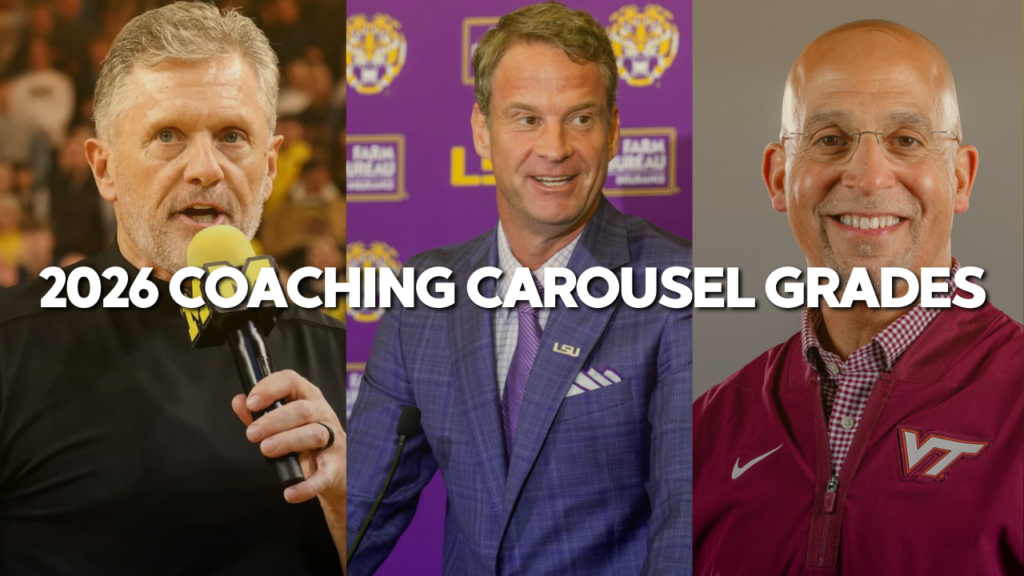
Every offseason, the coaching carousel takes center stage as staff turnover reshapes the college football landscape. A new hire can function as a cultural reset or a panic move made in search of quick results. The 2026 cycle delivered a compelling mix of home-run hires, ideal fits, and undeniable flops, 33 of them to be exact.
I evaluated every hire using four major criteria:
1. Coaching pedigree and career success
2. Fit in at their new school

3. Talent acquisition through the transfer portal and traditional recruiting
4. Projected impact during their first two years at the school
Here is how I view every new hire.
Table of Contents
Michigan – Kyle Whittingham
After a wild sequence of events and the firing of Sherrone Moore, Michigan ultimately stumbled into a major upgrade at head coach. In Whittingham, the Wolverines landed a leader who offers stability through clear structure and standards, dependable talent acquisition and development, and a long history of winning.
Over 22 seasons at Utah, Whittingham compiled a 177–88 (.668) record and went 11–6 in postseason play. He earned the 2008 Bear Bryant Coach of the Year Award, was a two-time Pac-12 Coach of the Year, produced 10 consensus All-Americans, and led the Utes to nine AP Top 25 finishes. The only knock on this hire is that he is 66 years old, but with that level of sustained success, Whittingham is a slam-dunk hire for Michigan.
Kyle Whittingham: A
Utah – Morgan Scalley
The quintessential successor to Whittingham at Utah, Morgan Scalley will bring continuity to the Utes program. The longtime, defensive-minded coordinator is finally getting his first shot as a big-time head coach at the Division I level. His aggressive, assignment-sound defense has been built on roster development through constant churn.
The early challenge for Scalley is that continuity doesn’t always lead to instant success. With the impact of staff building and offensive direction still to be determined, can Scalley pair his strong defensive identity with a dynamic offensive system behind returning QB Devon Dampier? Time will certainly tell.
Morgan Scalley: B-
California – Tosh Lupoi
Lupoi’s prowess and profile radiate recruiting energy, defensive pedigree, and top-to-bottom program alignment. As a Cal alumnus, Tosh Lupoi is a natural fit for the Golden Bears. He has led multiple defenses to elite levels, brings valuable NFL experience, and has been an exceptionally dynamic recruiter at every stop.
At just 44 years old, with previous coaching experience at Alabama, Washington, and multiple NFL teams, Lupoi has a chance to build something truly special at his alma mater. With phenom quarterback Jaron-Keawe Sagapolutele under center, Cal could be one of the most fascinating teams to watch in 2026.
Tosh Lupoi: A+
Stanford – Tavita Pritchard
From the outside looking in, Pritchard was an unconventional hire for the Cardinal. Jumping from NFL quarterbacks coach to college head coach is a significant leap for the former Stanford QB. However, he brings an intriguing profile to the role, emphasizing leadership, quarterback development, and alignment with the vision Stanford GM Andrew Luck is trying to build on The Farm.
Pritchard’s immediate impact on his alma mater remains uncertain. In today’s landscape, new coaches typically lean heavily on the transfer portal early in their tenure, yet Pritchard has no direct experience in modern college football. That lack of recent high-level college experience suggests he’ll face a steep uphill battle.
Tavita Pritchard: D+
Virginia Tech – James Franklin
While James Franklin’s tenure in State College didn’t end on the highest note, what he accomplished at Penn State was nothing short of remarkable. In 12 seasons with the Nittany Lions, Franklin went 104–45 (.698) with a 6–6 bowl record and delivered a Big Ten championship in 2016. Notably, he led Penn State to its first-ever College Football Playoff appearance, where the Nittany Lions won two games before ultimately falling to Notre Dame in the national semifinal.
Franklin is poised to make one of the biggest immediate impacts of any new head coach at his next stop. He has already secured a top-25 recruiting class, including 11 flips from Penn State, and numerous former Nittany Lion staffers are following him to Blacksburg. With that combination of talent and familiarity, Franklin should have the Hokies back in ACC contention in short order.
James Franklin: A
Iowa State – Jimmy Rogers
Iowa State acted swiftly upon Matt Campbell’s departure for Penn State with the hiring of Jimmy Rogers. Now, to the average college football fan, who is Jimmy Rogers? Aside from his one season at Washington State last season, where he went 6-6 and led the Cougars to a bowl appearance, Rogers is actually one of the most historically productive hires of this cycle. At FCS powerhouse South Dakota State, Rogers was on the 2022 staff, where the Jackrabbits won their first FCS title. Following in 2023, Rogers took over as head coach and didn’t miss a beat. SDSU went 15-0 and went back-to-back in the FCS National Championship. Rogers would also lead the program to a 12-3 record with a FCS Semifinal appearance in 2024.
So, how does this translate to Iowa State? Similar to his predecessor in Ames, Rogers has been known to do more with less. He has focused on player evaluation and development during his tenures as a head coach, while also building an offensive system that works for the players he has available to him. Overall, it is not the flashiest name on this list, but one I believe we could be looking back on in a few seasons.
Jimmy Rogers: B+
Kansas State – Collin Klein
Another underrated hire from this past cycle is new Kansas State head coach Collin Klein. During his playing days in Manhattan, Kansas, Klein was must-watch TV. In 2012, he won Big 12 Offensive Player of the Year, captured the Johnny Unitas Golden Arm Award (given to the nation’s top quarterback), and finished third in the Heisman voting, leading the Wildcats to an 11-win season and a Big 12 championship. After his playing career, Klein began coaching at K-State, eventually becoming offensive coordinator in 2022 and helping guide the Wildcats to another Big 12 title. He then spent the last two seasons as Texas A&M’s offensive coordinator under Mike Elko, helping the Aggies reach their first College Football Playoff.
Taking over for the newly retired Chris Klieman, Klein has big shoes to fill. If he can replicate the recruiting and talent acquisition success he had in College Station, Kansas State will be a team to watch in the Big 12 over the next few seasons. Plugging veteran quarterback Avery Johnson into this run-pass-option-based system could make K-State one of the most dynamic offenses in the country next season.
Collin Klein: A-
Oklahoma State – Eric Morris
The Oklahoma State Mean Green… I mean, Cowboys. The former North Texas head coach brings flair and explosive offensive firepower to the Big 12. Morris has been the architect of one of college football’s most explosive offenses, producing some of the most entertaining football you’ll see at this level. But will it translate from the American Conference? I’d like to think so.
Morris is bringing over his redshirt sophomore starting quarterback, Drew Mestemaker, who finished 2025 leading the nation in passing yards (4,379) and throwing 34 touchdowns. Joining him is his star sophomore running back, Caleb Hawkins, who led the nation in rushing touchdowns with 25. Along with several other standout North Texas players heading to Stillwater, time will tell whether this mass migration through the portal will pay off for Morris.
Eric Morris: B
North Texas – Neal Brown
Former West Virginia head coach Neal Brown takes over for Eric Morris at North Texas. Brown’s head coaching track record has been mixed. At Troy from 2015–2018, he guided the Trojans to a 35–16 record over four seasons and captured a Sun Belt championship in 2017. His time at West Virginia was less impressive, as he posted a 37–35 mark in six seasons, with a high point of 9–4 in 2023.
Whoever took the North Texas job was walking into a difficult situation, especially after the roster was stripped by the transfer portal. The Brown hire appears aimed at bringing in an experienced head coach to stabilize the program and salvage what remained of the previous team. Whether that approach will produce meaningful success over the next three seasons remains to be seen.
Neal Brown: C
Memphis – Charles Huff
Huff is a “builder who travels well” — a coach known for physical, organized football and a clear developmental philosophy. In his coaching career, Huff compiled a 32–20 record at Marshall, highlighted by a career-best 10-win season in 2024, before heading to Southern Mississippi, where he finished 7–5 in his lone season with the Golden Eagles. Now taking over at Memphis, who has been consistently good enough to expect winning seasons, but the challenge for Huff is maintaining a talented, focused roster in a league where top players are often poached.
The Year 1 priority is preserving Memphis’ identity as a serious program — nailing staff hires, winning in the portal, and maintaining week-to-week consistency. If he can keep the talent pipeline strong while emphasizing disciplined defense and efficient offense, Memphis can avoid the typical “reset year” that follows a coaching change.
Charles Huff: B+
South Florida – Brian Hartline
One of the top recruiters in this head coaching cycle, Brian Hartline, is finally taking over a program of his own. The former Ohio State wide receivers coach and offensive coordinator has been regarded as one of the nation’s best recruiters, particularly at wide receiver. After producing numerous NFL-caliber weapons at Ohio State, Hartline now looks to bring that same mentality to Tampa Bay and replicate his success with the Bulls.
Early returns suggest he’s on the right track. Hartline has engineered the No. 1 transfer portal class among Group of Five programs and the No. 53 class nationally, according to 247Sports. He managed this even after a large portion of the 2025 roster followed former USF head coach Alex Golesh to Auburn. With this momentum, USF appears to be an early contender for a College Football Playoff berth.
Brian Hartline: A+
Tulane – Will Hall
One of the more interesting hires of this cycle was Tulane promoting offensive coordinator Will Hall. The former Southern Mississippi head coach is a very underwhelming follow-up to Jon Sumrall, one of the better coaches in Tulane’s history, who led the Green Wave to their first College Football Playoff appearance before taking the same job at Florida.
Hall’s promotion is interesting precisely because it feels subpar. In his four seasons at Southern Miss, he went a staggering 14–30 (.318) and was fired during his fourth year in charge. While he has held previous high-level coordinator positions, such as at LSU, it is hard to overlook how disappointing his first head-coaching tenure was.
Will Hall: D-
UAB – Alex Mortensen
Mortensen stepping in from the interim role is the “stability in a storm” move — a program trying to calm the waters and re-establish direction. His promotion reflects an administration that clearly valued how he handled leadership and continuity through upheaval, and UAB’s job is usually about being structurally sound more than being trendy. His coaching path — rising through the ranks as a position coach and coordinator before earning the interim tag — underscores that he’s seen multiple sides of program building and day-to-day operations.
In Year 1, success hinges on his ability to recruit and keep enough talent while developing an identity suited to UAB’s roster and conference environment. A first-time head coach at a resource-limited program must focus on winning portal battles, earning the trust of high school coaches, and establishing clear communication about scheme, standards, and player roles from the start.
Alex Mortensen: D
Missouri State – Casey Woods
Woods’ rise follows a familiar offensive staff-and-recruiting path: build a reputation as a tight ends/run-game developer, then add credibility as a play-caller and organizer. Before Missouri State, he was best known as a trusted offensive “glue guy” who could coordinate, recruit, and tighten operational details.
At Missouri, he served as tight ends coach and recruiting coordinator during Eli Drinkwitz’s early roster build, a role that signaled influence beyond a single position room. Hired by Rhett Lashlee as offensive coordinator—later also chief of staff and tight ends coach—at SMU, he helped lead an explosive Mustangs offense that produced high-end scoring seasons, including an 11-win, conference-title campaign.
Résumé takeaway: Woods profiles less as a “celebrity play-caller” and more as a systems builder — someone trusted to run an offense, handle key recruiting duties, and keep staff operations organized.
Casey Woods: B
UConn – Jason Candle
Candle is a modern MAC staple—a coach who has built continuity and production through player development and a clearly defined offensive identity. He began at Mount Union, where coaching is rooted in detail, tempo, and teaching, then moved to Toledo and advanced from position coach to coordinator to head coach. From 2016 to 2025, he led Toledo to sustained success, including MAC titles in 2017 and 2022, regular bowl appearances, and the distinction of becoming the Rockets’ all-time winningest coach with 81 victories.
Candle is a program-and-offense stabilizer — a former CEO who can quickly raise week-to-week competence thanks to an established operational rhythm.
Jason Candle: A-
Ohio – John Hauser
Hauser’s promotion is a clear continuity-and-defensive move. The Bobcats are betting on someone who already knows the roster, the culture, and the MAC’s week-to-week realities. In this league, stability matters — and a coach who understands what wins in November can keep you in the title race every year. At Miami (OH), he spent a long stretch under head coach Chuck Martin, rising to co-defensive coordinator and helping guide several strong MAC defenses, including the 2019 conference title team. Next at Ohio, he arrived as safeties coach in 2022 and was quickly elevated to defensive coordinator. He was later named interim head coach and ultimately earned the full-time job after his bowl-game success.
Hauser is a defensive structure-and-culture continuity hire, with deep experience in the league’s recruiting footprint and style of play. His immediate impact will hinge on offensive efficiency and quarterback play (as it usually does in the MAC). If Hauser can maintain a strong defensive baseline while keeping the offense on schedule, Ohio should remain one of the league’s safer contenders.
John Hauser: C
Toledo – Mike Jacobs
Jacobs is a quintessential “fit hire” for Toledo—a program built on sustainable success, strong recruiting, and toughness. Toledo has long been one of the MAC’s most stable jobs, which means the next coach must prioritize continuity over wholesale reinvention. Jacobs fits that mold: he owns a 94–23 (.803) career record, ranking fourth among active coaches in NCAA Divisions I and II, and he’s built that résumé through consistently strong recruiting at Mercer, Lenoir-Rhyne, and Notre Dame College (Ohio).
In the short term, his value will be measured by how well he maintains Toledo’s standard: keeping the core roster intact, limiting staff turnover, and protecting the program’s edge in player development. If he sustains system coherence and continues to win narrow games, Toledo’s floor should remain high.
Mike Jacobs: B+
Kent State – Mark Carney
For Kent State, five wins in 2025 were considered a major success, making Carney’s promotion essential for the Golden Flashes. He provides continuity on offense as the former offensive coordinator and can now build and recruit fully to his vision as the program’s full-time head coach.
Mark Carney: B
Colorado State – Jim Mora
Mora is a veteran “culture and credibility” hire. Colorado State wants steadier leadership and a coach who can command a room, recruit effectively, and set expectations quickly in the new PAC-12. Mora’s recent track record at UConn—bowl seasons and a higher baseline—offers exactly what CSU wants: proof you can raise a program’s floor without perfect conditions.
His career breaks into two main chapters: a long NFL run as a defensive assistant and head coach, and then a return to college as a head coach with a clear “program builder” identity. If he can bring that approach to CSU—creating immediate impact through roster triage, portal additions, and turning close games into wins—then, with the Rams’ relative resource advantages, early defensive stabilization and a functional offense could quickly produce the consistency and on-field jump the program needs.
Jim Mora: B
Oregon State – JaMarcus Shephard
Shephard is an energy-and-offense hire, brought in to revive the program and its recruiting momentum. His career shows a steady rise from high school coaching to major-college offensive leadership, mainly through wide receiver and pass-game coordinator roles. At a volatile Oregon State, the job is as much about belief as scheme: a seasoned coordinator can reset standards and add new ideas, which fits the school’s focus on his coordinator and assistant head coach stops at Alabama and Washington.
His impact will hinge on whether he can stabilize the offensive line and quarterback play while maintaining strong recruiting pipelines. Shephard will also need to manage the roster effectively to keep pace in the PAC-12.
JaMarcus Shephard: C+
Washington State – Kirby Moore
Moore is Washington State’s offensive-identity hire — a young coach tasked with installing a modern scheme, clarifying the quarterback position, and selling recruits and transfers on a simple promise: “We will score and develop you.” At WSU, that means building a system that turns undervalued players into real production, then using that track record as the foundation of the program’s recruiting and transfer-portal pitch. His credibility comes from his rapid rise as a primary play-caller, moving from WR/pass-game positions to OC/QB roles while advancing through Washington, Fresno State, and Missouri before becoming WSU’s head coach.
In effect, Washington State is hiring the play-caller and trusting Moore to grow into the CEO role. The immediate impact of this hire will depend on his ability to navigate a roster rebuild in a volatile market, assemble a defensive staff that prevents WSU from being outmuscled each week, and secure steady quarterback play that can keep the program competitive despite inevitable turnover.
Kirby Moore: B-
Arkansas – Ryan Silverfield
Silverfield profiles as a serious, steady program operator—someone who has lived the day-to-day grind of building a winning team, recruiting, and maintaining standards. Arkansas is a brutal job when you’re unstable; the appeal here is his steadiness and competence: establish a consistent baseline first, then hunt for ceiling. A longtime line and offensive staff coach, Silverfield rose internally at Memphis from OL/run-game duties into the head role, where he was 50-24 in 6 seasons with the Tigers.
Silverfield’s résumé points to a trenches-and-structure coach whose calling card is maintaining a winning baseline and a clear offensive line/run-game identity. At Arkansas, his most immediate impact should be in elevating the program’s SEC recruiting posture, landing key portal additions (particularly on the OL and DL), and implementing an offensive plan that limits week-to-week volatility. If he can stabilize the roster and break the usual “one step forward, two steps back” pattern, the Razorbacks can operate more functionally in the short term — even if the record takes time to catch up.
Ryan Silverfield: B-
Auburn – Alex Golesh
Golesh is an offense-first hire, brought in to immediately energize Auburn with tempo, quarterback-friendly concepts, and a clear, explosive identity. Auburn chose him because today’s SEC is won with points and big plays, and his system can quickly reshape a team’s week-to-week identity. His reputation for leading modern, high-powered attacks comes from his success as Tennessee’s offensive coordinator and his turnaround work as USF’s head coach.
Golesh is a scheme, quarterback, and tempo specialist, tasked with modernizing Auburn’s offense right away. His immediate impact will depend on whether the Tigers can pair that offensive ceiling with SEC-caliber line play and real defensive toughness. If he recruits well—especially at quarterback once USF star transfer Byrum Brown moves on, and along the offensive line—while also nailing key staff hires, Auburn’s floor rises quickly. But in the SEC, there is almost no margin for error when it comes to these decisions.
Alex Golesh: B+
Florida – Jon Sumrall
Sumrall’s career is rooted in defense and program organization. He began as a graduate assistant at Kentucky, progressed through multiple assistant and coordinator roles, and ultimately became the head coach at Troy, where he led the Trojans to an impressive 23–4 (.852) mark during back-to-back Sun Belt championship seasons. Over the last two years, Sumrall guided Tulane to a 19–7 record, including a 10–2 campaign and an American Athletic Conference title in 2025. Tulane reached the College Football Playoff for the first time in school history but fell in the first round to Ole Miss.
Now taking over at Florida, Sumrall is poised to take his biggest step forward as a head coach. Entering one of the toughest conferences in the country, the Gators appear primed to return to the national spotlight. On the strength of strong recruiting and a productive portal haul (28th) in this year’s cycle, Sumrall is positioning himself for relatively immediate success in Gainesville.

Jon Sumrall: A
Kentucky – Will Stein
A modern offensive mastermind, the former Oregon offensive coordinator now looks to make his mark in the SEC. The first-time head coach has held numerous offensive and coordinator roles, producing highly successful attacks at every stop. Through Week 14 of 2025, Stein’s Oregon offense averaged 465.2 total yards per game, including nearly 218.4 rushing yards per game.
Now taking over as the Wildcats head coach, Stein looks to replicate that offensive output in Lexington for years to come. Kentucky was able to acquire a Top 15 portal class (11th), setting Stein up for a very productive and potentially underrated season. The future is looking very bright for the Wildcats.
Will Stein: A-
LSU – Lane Kiffin
Arguably, the most dramatic, soap-opera-like move of this cycle was LSU’s hiring of former Ole Miss head coach Lane Kiffin. Kiffin has held several high-profile positions in both the NFL (Raiders) and college football (USC, Tennessee), but none were as successful as his tenure in Oxford. Off-field drama aside, Kiffin owns an impressive career record of 116-53 (.686). During his six years at Ole Miss, the Rebels reached heights they had never seen before: a 55-19 overall record, a school-best 11 regular-season wins in 2025, and their first-ever College Football Playoff appearance—a game in which Kiffin did not coach due to his early departure for Baton Rouge.
Contrary to popular belief in the media, Kiffin did not lure many of his former Ole Miss players to join him. Instead, he assembled the top-ranked portal class, featuring three five-star prospects and eleven four-star prospects. This highly ranked class, along with the immediate-impact players Kiffin has added, is setting him up for instant success down on the bayou. Off-field drama aside, Kiffin is a home-run hire.
Lane Kiffin: A+
Ole Miss – Pete Golding
Long known as a defense-first coach, Golding was thrown into the fire immediately with the Rebels. Taking over in the wake of Lane Kiffin’s departure to LSU, he was named the new Ole Miss head coach just as the program entered its first playoff run in school history. The former Alabama defensive coordinator and first-time head coach then led Ole Miss to its first national semifinal, defeating Tulane and upsetting Georgia along the way.
Now entering his first full season as head coach, Golding is setting himself up to take Ole Miss back to the heights reached in 2025. Ole Miss has brought in the second-ranked portal class, including 9 four-star prospects, as well as star quarterback Trinidad Chambliss, getting approved to return in 2026. Can Golding translate his playoff success across a whole SEC schedule? We will soon find out.
Pete Golding: C-
Michigan State – Pat Fitzgerald
Having been out of coaching for the past few years, Pat Fitzgerald is now getting a new opportunity in 2026. The long-time Northwestern head coach has a record of 110-101 in 17 seasons with the Wildcats, with the highlights being two 10-win seasons in 2015 and 2017. With this being only his second head coaching position, Fitzgerald is ready to bring Michigan State back to the top of the Big Ten.
Fitzgerald brought the nation’s 55th-ranked transfer portal class to East Lansing. However, given his recent absence from college football, it is difficult to predict this far in advance how the Spartans will perform under his leadership.
Pat Fitzgerald: C
Penn State – Matt Campbell
In a saga that lasted more than 50 days, Penn State finally found James Franklin’s replacement and landed a top candidate: Matt Campbell. To the casual fan, Campbell might seem like a below-average hire for the Nittany Lions, but he is actually one of the most underrated coaches in college football. The former Mount Union assistant, Toledo head coach, and Iowa State head coach owns a 107–70 (.605) career record, which is impressive given the programs he has led.
Campbell guided Iowa State to eight winning seasons in his ten years in Ames, the most by any coach in school history. In 2024, the Cyclones enjoyed their best season ever, reaching their first Big 12 championship game and winning 11 games, the most in a single season for the program.
Now in State College, Campbell will look to replicate his “doing more with less” mentality. He has already brought more than 70% of his 2025 production with him from Iowa State. As a result, Penn State secured the No. 6 transfer portal class in 2026. Coupled with a favorable schedule next season, the Nittany Lions are well-positioned to make noise on the national stage this year and in the seasons to come.
Matt Campbell: A
UCLA – Bob Chesney
UCLA went outside the box by hiring Bob Chesney as its next head coach. Chesney has been a program builder throughout his career, with successful stops at Salve Regina, Assumption University, and Holy Cross, where he proved he could win at the Division III, Division II, and FCS levels. Taking over for former JMU head coach Curt Cignetti, Chesney continued his steady track record of success. In his two seasons at James Madison, he went 21–6, winning the Sun Belt in 2025 and finishing 12–2 that year after falling to Oregon in the first round of the College Football Playoff.
This hire is unconventional largely because of Chesney’s background. He has never coached west of the Rocky Mountains and has little to no experience recruiting on the West Coast. Even so, the Bruins brought in the nation’s 33rd-ranked transfer portal class. Stylistically, Chesney appears to be a strong fit; only time will tell whether that translates into sustained success in Los Angeles.
Bob Chesney: B
Coastal Carolina – Ryan Beard
Beard’s résumé follows the “young defensive mind to program leader” path, progressing from defensive support and DB coaching to coordinator and then head coach. His work at Missouri State during its transition and his head-coaching record there positioned him for Coastal. He arrives as a modern program-builder: strong on identity, talent evaluation, and sustaining competitiveness without major resources, tasked with preserving Coastal’s dangerous offensive-and-culture DNA while upgrading roster depth.
Ryan Beard: B-
James Madison – Billy Napier
Napier is a high-structure CEO-style coach, a major advantage at JMU, where organizational quality and development often separate the Sun Belt’s top tier. His edge is building systems — in recruiting, practice habits, and roster management — that create a consistent weekly floor. A clearly documented modern “process builder,” he rose through major assistant roles (including Alabama), proved he could run a successful, conference-contending program at Louisiana, then moved on to Florida, where he was lackluster, and now JMU.
Billy Napier: B
Southern Mississippi – Blake Anderson
Anderson’s career is heavily offense/QB‑oriented, highlighted by more than a decade as an FBS head coach with real conference title success at Arkansas State, plus stints at Utah State and Southern Miss (where he was previously OC/QB) before being elevated. His promotion signals Southern Miss wanted continuity and familiarity after a quick turnover; for a program that often fights for stability, an internal move can reduce roster loss and preserve recruiting relationships. But also taking into account his firing due to a Title IX investigation at Utah State, that knocks your grade all the way down.
Blake Anderson: F