


Fantasy football managers know that every lineup decision can make or break a week, and choosing the right players to start or sit is where championships are won. With the 2026 NFL season underway, matchups, stats, and trends are more important than ever. From favorable matchups and scoring trends to players you should avoid in tough spots, my weekly positional start and sit guide is built to give you an edge.
Want your start/sit questions answered within minutes? Join the Blitz Community for free fantasy football advice all season long.
Running Backs to Start
Rachaad White, RB (WAS)
Rachaad White is positioned for another substantial workload in Washington’s backfield with Jacory Croskey-Merritt sidelined on injured reserve by a groin injury. White has recorded 145 rushing yards, 14 receptions for 83 yards and two touchdowns across five appearances, but his recent involvement has been more encouraging than those season-long totals suggest. In his first start before Washington’s bye week, White played 70.5% of the offensive snaps, handled 41.2% of the rushing attempts and ran a route on 51.1% of dropbacks. His 12.5% target share also demonstrates that Washington is comfortable involving him in the passing game. White has scored at least 11.1 PPR points in three of his last four appearances, providing useful receiving involvement even when his rushing efficiency hasn’t been particularly impressive. However, Austin Ekeler and Jeremy McNichols remain available in the backfield, creating some uncertainty about whether White will maintain a dominant share of rushing and passing-down opportunities.
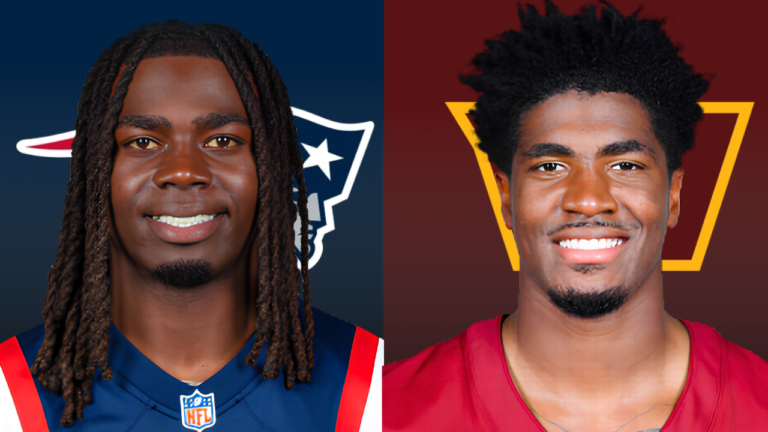
Philadelphia presents a favorable opportunity for White to build on his recent involvement, allowing at least one opposing running back to score 10.8 PPR points in five consecutive games. Kyren Williams, Chuba Hubbard and Javonte Williams have each exceeded 19 PPR points against the Eagles during that stretch, while Philadelphia has allowed the tenth-highest rushing success rate and fifth-most yards after contact per attempt over its last five games. Washington enters the matchup as a six-point favorite with an implied team total of approximately 23.2 points, creating opportunities for White to receive additional rushing attempts if the Commanders establish an early lead. I’m starting White as an RB2 or flex option because his receiving involvement, expanded role and favorable game environment provide a solid foundation for Week 8, although the presence of Ekeler and McNichols introduces some uncertainty about his overall workload.

Rhamondre Stevenson, RB (NE)
Rhamondre Stevenson has quietly become one of New England’s more dependable fantasy options, particularly because of his involvement in the passing game. Stevenson enters Week 8 with 285 rushing yards, 20 receptions for 204 receiving yards, and three total touchdowns. His rushing production was disappointing against Chicago in Week 7, finishing with just 22 yards on six carries, but he compensated with five receptions for 93 yards and a touchdown. That performance included a 48-yard receiving score and resulted in 22.5 PPR points, his third game with at least 17.5 points over his last four appearances. Over New England’s last three games, Stevenson has handled 33 carries and 11 targets compared with TreVeyon Henderson’s 14 carries and four targets, demonstrating that he’s maintained a substantial advantage in opportunities. However, Henderson and Corey Kiner remain involved in the rotation, creating some uncertainty about whether Stevenson can maintain that workload. His receiving role remains particularly valuable, with his 8.5 yards per target ranking second among running backs.
Miami has been one of the most favorable running back matchups in fantasy football, allowing the fourth-most fantasy points to the position this season. At least one opposing running back has scored 15.8 PPR points against the Dolphins in every game, demonstrating how consistently their defense has struggled to limit backfield production. Miami has also allowed successful plays on 56% of opposing offensive snaps, the highest rate in the NFL, while surrendering the eighth-most yards after contact per attempt and sixth-highest gap rushing success rate over its last five games. That matchup is particularly encouraging for Stevenson because approximately 68.8% of his rushing attempts have come on gap concepts. New England enters Sunday’s matchup as a seven-point favorite with an implied team total of approximately 25.2 points, creating opportunities for additional rushing volume if the Patriots establish an early lead. Henderson’s potential for increased involvement creates some risk, but Stevenson’s recent receiving production and favorable matchup outweigh those concerns. I’m starting Stevenson as a strong RB2 with upside for Week 8.
Chase Brown, RB (CIN)
Chase Brown has been one of fantasy football’s more frustrating running backs this season, entering Week 8 as the RB20 in fantasy points per game despite ranking 12th in expected fantasy points. He’s averaged 18.4 touches and 71.3 total yards per game, but has scored just one touchdown while struggling to generate consistent rushing efficiency. Brown is averaging only 3.5 yards per carry, while ranking 25th in yards after contact per attempt and 32nd in missed tackle rate among 42 qualifying running backs. Cincinnati’s offensive line hasn’t helped matters, with Brown ranking 33rd in yards before contact per attempt. However, his workload remains encouraging, as he’s received at least 15 touches in every game while handling 55.4% of Cincinnati’s rushing attempts compared with Samaje Perine’s 24%. Brown has also caught 28 passes, the fifth-most among running backs, providing a valuable receiving foundation even when his rushing production disappoints. His competition with Perine remains a concern, but the opportunities have consistently been there.
Tennessee presents an excellent opportunity for Brown to turn that substantial workload into a productive fantasy performance, especially following the reported trade sending star defensive tackle Jeffery Simmons to Chicago. The Titans were already struggling to defend the run, allowing 4.9 yards per carry and a 14.7% explosive run rate to running backs since Week 5. Over their last five games, Tennessee has surrendered the fourth-highest explosive run rate, fifth-highest rushing success rate, and seventh-most yards before contact per attempt. Losing Simmons would remove one of the defense’s most important interior players from an already vulnerable defensive front. Cincinnati enters the matchup as an 11.5-point favorite with an implied team total of approximately 29 points, creating an excellent opportunity for Brown to receive substantial rushing volume and additional scoring chances. Brown’s inefficient rushing production and competition with Perine remain concerns, but I’m starting him as a strong RB2 with RB1 upside because his consistent workload, favorable game script, and Tennessee’s weakened defensive front create an ideal opportunity for a breakout performance.

Blake Corum, RB (LAR)
Blake Corum has quietly developed into a legitimate fantasy option despite continuing to operate behind Kyren Williams in the Rams’ backfield. Since Week 5, Corum has totaled 37 touches for 233 yards and three touchdowns, emerging as one of the more productive running backs during that stretch. He handled 17 carries for 93 yards and a touchdown against Las Vegas in Week 7, compared with Williams’ 16 carries for 99 yards and a score, demonstrating that Los Angeles is increasingly comfortable distributing rushing opportunities between both players. Corum has handled approximately 35.8% of the team’s rushing attempts this season compared with Williams’ 54%, while averaging an impressive 4.9 yards per carry, the eighth-highest rate among 42 qualifying running backs. However, his receiving involvement remains extremely limited, with just a 3.6% target share compared with Williams’ 11.3%. That creates a relatively low fantasy floor when Corum doesn’t find the end zone, particularly because Williams continues handling more passing-down opportunities.
The Chargers have allowed approximately 24.7 PPR points per game to opposing running backs, creating an encouraging matchup for Corum and the Rams’ rushing attack. Los Angeles enters Sunday’s game as a 6.5-point favorite with an implied team total of approximately 26 points, providing opportunities for both Corum and Williams to remain involved if the Rams control the game. The Chargers have also struggled offensively, averaging just 15 points per game, which could encourage the Rams to lean more heavily on their running backs rather than relying on Matthew Stafford to carry the offense. Corum has already scored three red-zone touchdowns and demonstrated that he can generate explosive rushing plays without needing a featured workload. However, his limited receiving involvement and secondary role make him considerably more volatile than his recent production suggests. I’m starting Corum as a deeper-league flex option with RB2 upside because his recent rushing efficiency and favorable game script create an opportunity for another productive performance, although he’s not someone I’d force into a lineup over a more dependable starter.
Running Backs to Sit
Denver Broncos Running Backs, RB (DEN)
Denver’s backfield has become increasingly difficult to trust as Sean Payton continues adjusting the workload between J.K. Dobbins, RJ Harvey and Jonah Coleman. Dobbins scored a rushing touchdown against Arizona in Week 7, but finished with just 23 rushing yards on six carries while playing approximately 23% of the offensive snaps. That was a significant decline from his previous workload, particularly with Coleman returning from injury and immediately leading the backfield in snaps and rushing attempts. Coleman played approximately 49% of the snaps and handled nine carries, finishing with 69 total yards on 11 touches, while Harvey played 26% of the snaps and received three rushing attempts. Harvey’s receiving touchdown helped salvage his fantasy performance, but his reduced rushing involvement creates considerable uncertainty about his weekly opportunities. Coleman also led the backfield in routes, and Payton has indicated that he needs additional opportunities moving forward. With three running backs competing for touches, none currently offers a dependable workload, although Coleman’s recent involvement makes him the most intriguing option.
Kansas City makes this backfield even more difficult to trust, allowing just 73.7 rushing yards per game to opposing running backs, the fifth-fewest in the NFL. The Chiefs have also allowed the eighth-lowest explosive run rate, seventh-lowest rushing success rate, and fourth-lowest missed tackle rate over their last five games. Kansas City’s defense has been particularly effective near the goal line, surrendering the second-lowest red-zone touchdown rate in football at approximately 26.7%. That creates problems for Dobbins, whose recent fantasy production has been heavily dependent on touchdowns, while Harvey’s limited rushing workload makes him difficult to trust without another explosive receiving play. The matchup also carries a relatively low 40.5-point total, creating concerns about the number of scoring opportunities available. Coleman has the most encouraging recent usage, but his role remains uncertain still despite him trending in the right direction. I’m sitting Dobbins and Harvey in Week 8, while viewing Coleman as nothing more than a desperation flex option until Denver establishes a more predictable backfield rotation.

Emanuel Wilson, RB (SEA)
Emanuel Wilson has taken advantage of Seattle’s depleted backfield, emerging as a productive fantasy option while Zach Charbonnet and Jadarian Price have been sidelined. Wilson rushed for 100 yards against Kansas City in Week 7, finishing with 18.5 fantasy points while continuing to handle a substantial share of Seattle’s rushing workload. He’s now scored at least 13 fantasy points in three of his last four appearances, demonstrating that he can produce when given consistent opportunities. However, Wilson’s recent success has been driven primarily by his expanded role rather than an established position atop Seattle’s depth chart. His receiving involvement has also been extremely limited, accounting for just 3.6% of the team’s targets, making him heavily dependent on rushing volume and touchdowns. That becomes a significant concern with multiple teammates nearing their returns, potentially creating a more crowded backfield than the one Wilson has benefited from over the last several weeks.
Seattle could have both Charbonnet and Price available against Chicago, creating substantial uncertainty surrounding Wilson’s Week 8 workload. Charbonnet is working toward his season debut after recovering from a torn ACL, while Price has been designated to return from injured reserve following a chest injury. However, Seattle hasn’t committed to either player being available, meaning Wilson could still maintain a substantial workload if both remain sidelined. Chicago also presents a difficult matchup, allowing approximately 19.2 PPR points per game to opposing running backs, making it the seventh-toughest defense against the position. I’m sitting Wilson if Charbonnet or Price returns to a meaningful role, as their involvement would create too much uncertainty about his rushing volume and touchdown opportunities. However, if both remain sidelined, Wilson would remain a viable volume-based flex option despite the difficult matchup against Chicago.
Jordan Mason, RB (MIN)
Jordan Mason returned from a four-game absence caused by a thumb injury against Indianapolis in Week 7, recording 15 carries for 68 yards while failing to catch either of his two targets. His workload was encouraging after an extended absence, particularly because Minnesota was willing to give him substantial early-down opportunities immediately upon returning. Mason also led Aaron Jones in offensive snaps, routes, and touches during that game, demonstrating that he could maintain a significant role even when both running backs are available. He’s handled approximately 40.5% of Minnesota’s rushing attempts this season, the largest share of any Vikings running back, although his 5.5% target share demonstrates how limited his receiving involvement has been. Jones also suffered a knee injury against Indianapolis and missed practice earlier this week, potentially opening the door for Mason to receive additional opportunities. While that development could increase his rushing workload, Minnesota’s offense has struggled to consistently sustain drives, limiting the number of scoring chances available to its running backs.
Detroit presents a complicated matchup because its defense has struggled against quarterbacks while remaining considerably more effective against opposing running backs. The Lions have allowed approximately 20.8 PPR points per game to the position, making them the 11th-toughest matchup for running backs. Minnesota’s offensive inefficiency is another concern, as the Vikings have recorded successful plays on just 41% of their offensive snaps, the fourth-lowest rate in the NFL. Mason could benefit from additional carries if Jones remains sidelined, but his limited receiving role creates a narrow path toward a strong fantasy performance if Minnesota falls behind. Detroit’s offense is also capable of forcing opponents into pass-heavy game scripts, potentially reducing Mason’s opportunities on the ground. I’m sitting Mason if Jones is active and expected to share the backfield, but if Jones is ruled out, Mason becomes a viable volume-based flex start despite the difficult matchup.
Jeremiyah Love, RB (ARI)
Jeremiyah Love has struggled to establish a dependable fantasy role in Arizona’s crowded backfield, averaging approximately 13.4 carries and 49 rushing yards per game across five appearances. He’s also contributed 11 receptions for 36 receiving yards and a touchdown, but his overall production has been inconsistent while sharing opportunities with Tyler Allgeier and Bam Knight. Love has missed the last two games because of an ankle injury, allowing Arizona to distribute its rushing workload between Allgeier and Knight. During Love’s absence, Knight provided an unexpected spark, rushing for 80 yards on 15 carries against Los Angeles, while Allgeier continued receiving substantial early-down opportunities. When healthy, Love has handled approximately 43.7% of Arizona’s rushing attempts compared with Allgeier’s 28.3%, demonstrating that he previously maintained the largest rushing share. However, Love returned to practice on a limited basis Wednesday, and his uncertain health creates questions about whether he’ll immediately reclaim that workload.
Dallas presents an appealing matchup on paper, allowing approximately 25.2 PPR points per game to opposing running backs while struggling to prevent efficient offensive production. However, Love’s workload is far less certain than the matchup suggests, particularly after missing consecutive games and returning to practice with an ankle issue. Allgeier is also dealing with a toe injury, while Knight has demonstrated that he can contribute when given opportunities, making Arizona’s backfield especially difficult to project. The Cardinals enter the game as seven-point underdogs, creating the possibility of a pass-heavy game script that could further complicate the rushing workload. If Allgeier is ruled out, Love could receive enough work to justify flex consideration, assuming he’s healthy enough to handle a substantial workload. However, I’m sitting Love for now because his ankle injury, competition for carries, and uncertain playing time outweigh the favorable matchup.