


wo weeks of fantasy scoring data are in the books for 2026, and the numbers tell a clearer story than the box scores do. Three startable quarterbacks got hurt in the middle of strong fantasy weeks. A QB2 sitting on your waiver wire has outscored half the league’s starters. A defense at 1-1 has turned into the week’s best streaming asset. Every storyline below runs through weekly fantasy point totals, positional finishes, and usage numbers from Week 1 and Week 2.
Penix Named Starter for Thursday Night: What the QB Change Means for Falcons Fantasy Assets
Michael Penix Jr. takes over as the Falcons’ starter for Thursday Night Football against the Packers, and the fantasy case for the move is written in Cooper Rush’s numbers. Rush went 12-of-22 in a Week 1 loss, and Atlanta’s passing-game production collapsed around him: Drake London managed 2 catches for 29 yards on 4 targets, and Kyle Pitts turned 1 target into a dropped-pass zero, finishing Week 1 with 0.0 fantasy points at tight end. Week 2 barely moved the needle. London improved to 4 catches for 51 yards in a 34-3 blowout loss to Carolina, good for roughly 9 PPR points and still well below his ceiling.
Bijan Robinson does not need a quarterback change to matter. He accounted for 65.8 percent of Atlanta’s yards from scrimmage in Week 1 and stays a locked-in RB1 regardless of who takes snaps under center. London and Pitts are the two assets whose value swings hardest on this move. Both were startable on volume even with replacement-level quarterback play. A real starter is the difference between London as a low-end WR3 and London as a weekly WR2, and between Pitts sitting at zero points and Pitts hitting his TE1 red-zone upside.
Treat Penix as a streaming QB2 in two-quarterback formats rather than a locked Week 3 start. Short-week reps are limited, and he brings zero fantasy data points of his own this season.

Bryce Young Might Win Your Fantasy League: The QB2 Overall Through Two Weeks
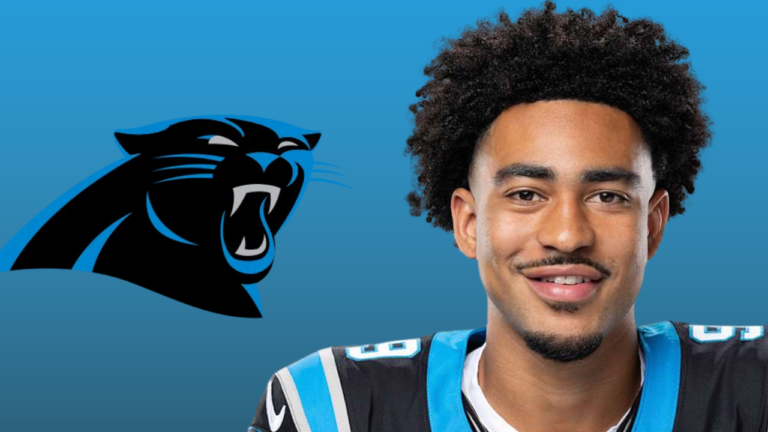
Bryce Young has outscored every quarterback in football except one through two weeks. His numbers: 31.4 fantasy points in Week 1, trailing only Caleb Williams’ league-leading 37.3, and 24.1 in Week 2, for 55.5 combined and a season average of 27.8 points per game. That average ranks him QB2 overall, ahead of players who go three or four rounds earlier in fantasy drafts.
The box scores back up the fantasy points. In Week 1, Young went 23-of-37 for 361 yards with 3 passing touchdowns and 1 interception, then added a 7-yard rushing score for 4 total touchdowns on the day. In Week 2, he cut the turnovers out completely: 23-of-36 for 287 yards, 3 more passing touchdowns, zero interceptions, and targets spread to Tetairoa McMillan and Darren Waller, who caught 2 touchdown passes of his own.
Young is still sitting on waiver wires in a meaningful share of leagues. A QB2 overall scoring pace, with the turnover rate dropping to zero in Week 2, is not streaming-only value. If your quarterback spot is shaky or a bye week is coming, this is a top-12 weekly option available for free in a lot of rosters right now.
Kansas City’s Defense Is the Week’s Best Stream: 13 Points in Week 1, a Correction in Week 2, and a Get-Right Spot Against Miami
The Chiefs defense scored 13 fantasy points in Week 1, built on 4 sacks and an interception. Week 2 delivered a reality check: despite an overtime win over the Colts, Kansas City’s defense managed 1.0 fantasy point, having allowed 30 points and recorded a single interception with no sacks. Fantasy defenses swing that way, and Week 3 sets up as a correction back toward the Week 1 line.
Miami has scored 13 points in each of its first two games and lost both, a 27-13 defeat to the Raiders and a 35-13 loss to the 49ers. Blitz Sports Media’s Week 3 defensive streamers column called this pairing a “dream matchup,” setting the Chiefs against a “miserable” Dolphins offense. The betting market agrees: Kansas City opened as a 10.5-point road favorite, one of the largest lines of the week.
A defense facing an 0-2 offense that has not topped 13 points in either game, in a game the market expects to be a blowout, ranks among the safest plays fantasy football offers in Week 3. If Kansas City’s defense sat on your wire through that quiet Week 2 line, this is the spot to buy back in.
Kayshon Boutte Still Hasn’t Become a Fantasy Factor in Houston
Boutte’s fantasy line through two weeks: 3.1 points in Week 1, 6.7 points in Week 2, for a 4.9-point weekly average that ranks him WR79 in PPR scoring this season. Neither week has come close to fantasy relevance.
The usage explains why. In Week 1, Boutte was targeted on 2 of 25 routes run and played under 46 percent of Houston’s offensive snaps, well behind the workloads given to Nico Collins, Dalton Schultz, and Xavier Hutchinson. He finished with 1 catch for 21 yards. Collins’ hamstring injury opened the door in Week 2, and Boutte’s target count barely moved: 3 catches on 5 targets for 37 yards against Cincinnati, a game Houston lost 20-6. Houston’s multi-tight-end formations cap his target share further, even with the team’s top receiver sidelined.
Collins is expected to miss more time, so Boutte’s opportunity exists on paper. WR79 production says the target share has not followed. Stash him in deeper PPR formats on name value and opportunity alone. He does not earn a confident weekly start until the target count climbs well past 5.
The Blue Medical Tent Strikes Again: Three Fantasy Quarterbacks Cut Short Mid-Production
All three of this week’s marquee QB injuries hit players in the middle of legitimate fantasy performances, which makes the Week 3 fallout worse for the skill players attached to them.
Jaxson Dart put up 26.6 fantasy points in Week 1, going 23-of-29 for 230 yards and 3 touchdowns with zero interceptions, plus 54 rushing yards on 11 carries. Week 2 ended almost immediately: 3-of-5 for 20 yards and 0.8 fantasy points before a hit sent him to the medical tent with a sprained MCL. He tried to re-enter the game, and the team held him out as a precaution. X-rays came back negative, and a Tuesday MRI should clarify the severity; early word points to a manageable injury rather than a season-ending one. If Dart sits, Jameis Winston takes over, which is what happened for the rest of Week 2: 11-of-27 for 111 yards, 0 touchdowns, 1 interception. That is a real downgrade for Malik Nabers, Cam Skattebo, and the rest of the Giants’ pass-catching corps, even against a favorable matchup on paper against Tennessee.
Jayden Daniels put up 17.7 fantasy points in Week 1 (18-of-34, 164 yards, 2 touchdowns, plus 5 carries for 31 yards) before a dislocated left elbow ended his Week 2 early. He had already banked 14.7 fantasy points in that partial game, going 11-of-17 for 96 yards and a touchdown while adding 7 carries for 69 yards on the ground. Marcus Mariota takes over with no confirmed timeline for Daniels’ return, dropping Terry McLaurin and Stefon Diggs to risky flex plays until Washington’s offense proves it can function without him.
Caleb Williams led all fantasy quarterbacks in Week 1 at 37.3 points before a hamstring injury cut his Week 2 short at 7.7 points (15-of-26 for 138 yards, 1 interception, 42 rushing yards on 5 carries). Head coach Ben Johnson does not expect him to practice this week and has stopped short of ruling him out for Monday night against Philadelphia. If Williams cannot go, Tyson Bagent starts, a hard fantasy downgrade for Rome Odunze, Luther Burden III, and Colston Loveland.
Check all three practice reports through Wednesday and Thursday. Anyone rostering Nabers, Skattebo, McLaurin, Diggs, Odunze, or Loveland on a shallow bench needs a contingency plan before lineups lock.
Travis Kelce’s Fantasy Line Is Trending Up, and Miami Could Push It Higher
Kelce’s weekly fantasy points moved in exactly the direction you want heading into a plus matchup: 10.1 points in Week 1 (3 catches, 5 targets, 71 yards), then 25.1 points in Week 2 (9 catches, 11 targets, 101 yards, 1 touchdown). Across two games, that is 12 receptions on 16 targets for 172 yards and a touchdown, a 75 percent catch rate, and a 17.6-point weekly average that puts him back among the position’s top scorers.
Miami’s defense has spent too much time on the field behind an offense that has not scored more than 13 points in either game. A defense chasing points that often opens up extra volume for the opponent’s top target, and Kelce’s 11 targets in Week 2 already show what that volume looks like in a favorable game script. Kelce does not need positive regression to keep climbing. He needs Kansas City to control the game the way this matchup projects, and both the Week 1 defensive numbers and the Week 2 collapse in Miami point toward exactly that.
Waiver Wire Running Backs by the Numbers: Bigsby, Coleman, Black, and Spears
Fantasy points, not just opportunity, separate this week’s four most-added backs.
Tank Bigsby scored 0.3 fantasy points in Week 1 on a single carry, then jumped to 11.8 points in Week 2 (13 carries for 33 yards and a touchdown, plus 2 catches for 5 yards) once Saquon Barkley left with a first-snap shoulder stinger. That is 12.1 total points across two weeks, nearly all of it from the one game Bigsby played a real role. Barkley’s own evaluation sounds optimistic, but Bigsby stays the direct handcuff with real RB2 upside if the stinger lingers into Week 3.
Jonah Coleman put up 11.8 fantasy points in Week 2 (10 carries for 39 yards and a touchdown, plus 3 catches for 19 yards) after J.K. Dobbins and RJ Harvey both went down with hamstring injuries in Denver. He sits rostered in only about 32 percent of leagues, which makes him the most added name of the week across the industry. Sean Payton’s preseason praise for Coleman suggests this workload is not a one-game accident.
Kaelon Black’s fantasy points went backward: 7.0 points in Week 1 on 14 carries for 65 yards, down to 2.5 points in Week 2 on 7 carries for 25 yards with zero targets. That drop lines up with Christian McCaffrey taking on more of the workload as San Francisco’s Week 2 game against Miami played out. Black stays rosterable as ballast behind McCaffrey, but the Week 2 numbers argue against a real role increase in Week 3.
Tyjae Spears opened the season with 2.4 fantasy points in Week 1 (3 carries for 12 yards, 2 catches on 4 targets for 12 yards, including a third-quarter drop that cost Tennessee a first down). Tony Pollard remains the clear lead back, and Spears’ Week 1 line was thin enough that rookie Nick Singleton is now pushing for early-down work too. Spears is the most speculative name here, a bench stash tied to an injury elsewhere on the depth chart rather than a Week 3 add with standalone value.
The Bottom Line
Every trend line here points the same direction heading into Week 3. Bryce Young is outscoring all but one quarterback in fantasy football. Kansas City’s defense is due for positive regression after a quiet Week 2. Travis Kelce’s weekly point total is climbing into a plus matchup. Three injured quarterbacks have created real, fantasy-point-driven downgrades for the skill players around them. Set lineups off the weekly scoring data, not last year’s name value, and add Bryce Young or Jonah Coleman before the rest of your league catches up to the numbers.
Check out my latest article on Substack for free