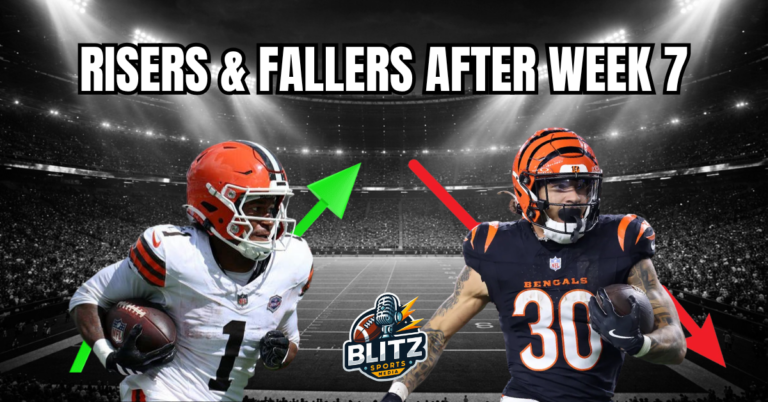



Week 7 brought several significant developments across the fantasy football landscape, from Cam Skattebo’s resurgence after being benched to Jonah Coleman’s return complicating Denver’s backfield. Tony Pollard delivered one of the biggest performances of the season, while players like Chase Brown and Ashton Jeanty showed why playing time and receiving involvement can be more important than rushing production alone. Injuries, changing backfield rotations and shifting target shares continue to reshape fantasy values as we approach the second half of the season.
Below are 14 takeaways from Sunday’s action, focusing on what happened, why it matters and how I’d approach each situation moving forward.
1) Cam Skattebo, RB (NYG)
One week after being benched and playing just six offensive snaps, Cam Skattebo responded with 17 carries for a career-high 124 rushing yards and a touchdown against Houston, finishing with 19.1 PPR points. He accounted for 17 of New York’s 28 running back carries, a 60.7% share, while Tyrone Tracy Jr. handled six attempts and Devin Singletary received five. More importantly, Skattebo was already leading the backfield before Tracy suffered a hamstring injury, playing 17 snaps over the Giants’ first four drives compared to Tracy’s 10. After Tracy exited, Skattebo handled more early-down opportunities while Singletary remained involved in passing situations. Skattebo also forced missed tackles on one-third of his touches and tied his career high with four explosive runs, demonstrating the physicality that made him an intriguing fantasy option earlier in the season. However, he caught his only target for minus-three yards, highlighting a receiving role that continues limiting his PPR floor. I’m encouraged by his response after last week’s benching, but Tracy’s eventual return could complicate the rotation again. Skattebo is back in the RB2 or flex conversation, although his limited receiving involvement makes him more dependent on rushing efficiency and touchdowns.
2) Ollie Gordon II, RB (MIA)
Ollie Gordon II has transformed Miami’s backfield, delivering another impressive performance with 25 carries for 103 yards and a touchdown against the Jets, finishing with 17.3 PPR points. He handled 25 of Miami’s 31 running back carries, an 80.6% share, while Jaylen Wright received the other six attempts. Gordon’s playing time was even more encouraging than his rushing workload, as he played 42 of Miami’s first 52 offensive snaps and 12 of 13 in the fourth quarter, accounting for approximately 83% of the available running back snaps. Wright also suffered a quad injury, while Kaytron Allen didn’t play an offensive snap, further strengthening Gordon’s control of the backfield. He’s now recorded at least 88 rushing yards and a touchdown in three consecutive games, establishing himself as Miami’s clear primary runner. The biggest concern remains his limited receiving involvement, as he caught just one of three targets for zero yards against New York. However, his substantial playing time, rushing volume and goal-line opportunities have become difficult to ignore. I’m treating Gordon as a dependable RB2 moving forward, although his ceiling remains tied to Miami’s ability to stay competitive and generate scoring opportunities.

3) Chase Brown, RB (CIN)
Chase Brown struggled against Baltimore in Week 7, finishing with 11 carries for 39 yards while catching four of five targets for 19 yards, totaling 9.8 PPR points. However, his underlying workload was considerably more encouraging than the box score suggests. Brown played 75% of Cincinnati’s offensive snaps, including 81% of normal early downs and 80% of third downs, demonstrating that he remains heavily involved despite Samaje Perine vulturing touches before the bye week. Brown handled 11 of Cincinnati’s 18 running back carries, while Perine received four attempts and scored a rushing touchdown, further limiting Brown’s fantasy production. That’s the frustrating part of his current situation: the Bengals’ offense is producing with Joe Burrow, but Brown isn’t consistently benefiting from those scoring opportunities. His five targets and substantial passing-down involvement provide a dependable foundation, although his rushing efficiency and touchdown opportunities remain inconsistent. I’m still interested in buying low because his playing time suggests he’s much closer to a featured back than his 61.1% rushing share indicates. Brown remains an RB2 with RB1 upside if Cincinnati’s offensive improvement begins translating into more efficient rushing production and scoring opportunities.
4) Josh Jacobs, RB (GB)
Josh Jacobs made an immediate fantasy impact in his first game back, handling 11 carries for 36 yards while catching five of seven targets for 55 yards and a touchdown against Detroit, finishing with 20.1 PPR points. His receiving involvement was particularly encouraging because Green Bay struggled to establish the run, finishing with just 60 total rushing yards. However, Jacobs played just over half of the Packers’ offensive snaps, demonstrating that he hasn’t immediately returned to a full-time workload. MarShawn Lloyd handled six carries and earned two targets, while Savion Williams also received two rushing attempts. Jacobs accounted for 11 of Green Bay’s 17 running back carries, a 64.7% share, and his seven targets represented approximately 16.7% of the team’s targeted passing attempts. Green Bay also didn’t employ a consistent passing-down or drive-by-drive rotation, making it difficult to predict exactly how opportunities will be distributed moving forward. I’m encouraged by Jacobs’ receiving involvement and ability to produce despite limited rushing efficiency, but his playing time suggests fantasy managers shouldn’t automatically expect his previous workload to return immediately. He’s back in the RB2 conversation with upside if his snap share increases.
5) Ashton Jeanty, RB (LV)
Ashton Jeanty’s rushing struggles continued against the Rams, but his receiving involvement completely rescued his fantasy performance. Jeanty managed just 15 rushing yards on eight carries, averaging an abysmal 1.9 yards per attempt, but caught all eight of his targets for 61 yards and a touchdown to finish with 21.6 PPR points. His receiving production accounted for 20.1 of those points, demonstrating just how important his passing-game role has become in an offense struggling to establish the run. Jeanty’s eight targets represented approximately 18.6% of Las Vegas’ pass attempts, while Mike Washington Jr. also received six carries for 27 yards, further complicating the rushing workload. The Raiders’ backfield rotation has become increasingly concerning, and their offensive line continues struggling to create consistent running lanes. However, eight receptions provide an enormous advantage in full-PPR formats, particularly when Las Vegas falls behind, and Kirk Cousins is forced to throw. I’m still concerned about Jeanty’s rushing efficiency and the growing competition for carries, but his receiving involvement gives him a legitimate path toward RB2 production even when the ground game isn’t working. He’s a player I’d continue starting in PPR leagues rather than overreacting to his disappointing rushing totals.
6) Tony Pollard, RB (TEN)
Tony Pollard delivered one of the biggest fantasy performances of Week 7, turning 25 carries into 129 rushing yards and three touchdowns while adding three receptions for 26 yards against Cleveland. His 36.5 PPR points were a massive reward for fantasy managers who stuck with him, but I’m treating this as an opportunity to sell rather than evidence of a permanent breakout. Pollard handled 25 of Tennessee’s 28 running back carries, an 89.3% share, while Michael Carter received the remaining three attempts. His early-down involvement increased with Tyjae Spears unavailable, although his passing-down participation remained limited, creating concerns about his ability to consistently produce when Tennessee falls behind. The Titans also increased their use of no-huddle offense, generating additional opportunities that may not continue every week. Pollard entered the matchup with just one rushing touchdown this season, making his three-score performance particularly difficult to project moving forward. Spears’ eventual return could create additional competition, but the bigger concern is Tennessee’s inconsistent offense and Pollard’s limited receiving ceiling rather than assuming his rushing workload will disappear. I’d actively explore trading Pollard to a manager who views him as a high-end RB2 after this performance.
7) Jonah Coleman, RB (DEN)
Jonah Coleman returned from injured reserve in Week 7 and immediately complicated Denver’s running back rotation, recording nine carries for 54 yards while adding two receptions for 15 yards against Arizona. His 11 touches and 69 total yards were particularly encouraging because he led the backfield in rushing attempts despite making his first appearance since returning from injury. Coleman also played nearly half of Denver’s offensive snaps and led the running backs in early-down, third-down, and short-yardage usage, suggesting his role was considerably more substantial than a typical rotational option. J.K. Dobbins managed just six carries for 23 yards but converted Denver’s only goal-line running back snap into a touchdown, while RJ Harvey contributed 60 scrimmage yards on five touches. That creates an extremely difficult situation for fantasy managers because Coleman appears to be emerging as the preferred option between the 20s, Dobbins remains involved near the goal line, and Harvey continues providing receiving upside. I’m concerned that Sean Payton will continue rotating all three players based on situation rather than establishing one dependable option. However, Coleman’s immediate playing time and involvement make him a priority waiver-wire addition rather than simply a speculative stash. He has a realistic path toward becoming Denver’s most valuable fantasy running back if his role continues expanding.
8) Colston Loveland, TE (CHI)
Colston Loveland is officially back on the fantasy radar after catching seven of 12 targets for 69 yards and a touchdown against New England, finishing with 19.9 PPR points. He’s now recorded at least six receptions, 65 receiving yards, and a touchdown in consecutive games, demonstrating how quickly his role has expanded since Caleb Williams returned. Over those two games, Loveland has commanded a reported 30.2% target share, 38.5% air-yard share and 50% of Chicago’s red-zone targets, leading the team in all three categories. Those usage figures are especially encouraging because his production is being driven by legitimate receiving involvement rather than relying exclusively on touchdowns. Williams has clearly made Loveland one of his preferred options, and that connection gives him a much more dependable weekly outlook. I’m treating Loveland as a locked-in TE1 moving forward, with the upside to finish among the position’s top five if this target volume continues.
9) Juwan Johnson, TE (NO)
Juwan Johnson has gone from a dependable early-season fantasy option to someone I’m comfortable dropping in most standard-sized, one-tight-end leagues. He caught just one of three targets for seven yards against Pittsburgh, giving him only 23 receiving yards and zero touchdowns over his last three games after opening the season with four consecutive performances of at least 50 yards. The bigger concern is his declining role within New Orleans’ offense, as Noah Fant and Oscar Delp have increasingly cut into his playing time. Johnson has now run routes on fewer than 60% of dropbacks in consecutive games, while Fant has increasingly replaced him on third downs and Delp has become more involved in multiple-tight-end formations. That combination makes it difficult to project the consistent target volume Johnson needs to remain fantasy relevant. With New Orleans entering its bye week and additional receiving competition potentially returning afterward, I’m comfortable dropping Johnson for a more dependable tight end or a higher-upside waiver-wire stash. I’d still consider holding him in deeper leagues or tight end premium formats where viable replacements are harder to find.
10) J.J. McCarthy, QB (NYG)
J.J. McCarthy followed his impressive Week 6 relief appearance with another encouraging passing performance in his first start for the Giants, completing 20 of 28 passes for 252 yards against Houston. He averaged 9.0 yards per attempt without throwing an interception, although he failed to record a passing touchdown, was sacked three times, and contributed just one rushing yard on one carry, finishing with 10.18 fantasy points. After throwing for 243 yards and a touchdown in limited action against New Orleans the previous week, McCarthy has demonstrated some encouraging downfield passing ability despite his limited experience in New York’s offense. His supporting cast also provides legitimate upside, particularly with Malik Nabers serving as a dependable primary receiving option and Malachi Fields becoming increasingly involved. McCarthy isn’t someone I’m ready to trust as a weekly fantasy starter, especially without consistent rushing production, but his willingness to attack downfield makes him more interesting than most quarterbacks available on waivers. With the Giants entering their bye week, I’d consider stashing McCarthy in deeper leagues and superflex formats before his role becomes more established.
11) Patrick Mahomes, QB (KC)
Patrick Mahomes’ fantasy outlook has become increasingly concerning, and I’m reaching the point where I wouldn’t consider him untouchable in one-quarterback leagues. Mahomes completed just 19 of 33 passes for 165 yards, zero touchdowns, and an interception against Seattle in Week 7, adding only 14 rushing yards and finishing with 5.0 fantasy points as Kansas City suffered a 20–3 loss. He averaged just 5.0 yards per attempt, continuing a frustrating stretch for an offense dealing with significant injuries at wide receiver and offensive tackle. Rashee Rice and Tyquan Thornton have been unavailable, while injuries to Josh Simmons and Jaylon Moore have created additional concerns about the protection in front of Mahomes. The bigger fantasy issue is that Mahomes isn’t providing enough rushing production to compensate when Kansas City’s passing attack struggles, leaving him heavily dependent on passing touchdowns and offensive efficiency. With a difficult upcoming schedule and limited explosive receiving options, I’m no longer comfortable starting Mahomes simply because of his name. I wouldn’t automatically drop him in every format, but in shallow one-QB leagues where a more productive option is available, I’m willing to move on rather than continue waiting for a turnaround.
12) Omar Cooper Jr., WR (NYJ)
Omar Cooper Jr. is quickly becoming one of the most exciting young receivers in fantasy football after catching all five of his targets for 115 yards and a touchdown against Miami. He’s now recorded at least five receptions, 100 receiving yards and a touchdown in consecutive games since returning from injured reserve, immediately establishing himself as one of the Jets’ most explosive receiving options. Cooper caught six of seven targets for 103 yards and a touchdown in his previous appearance, giving him 218 receiving yards and two touchdowns over his last two games. Garrett Wilson remains the established primary option in New York’s passing attack, but Cooper has demonstrated that he doesn’t need an overwhelming target share to deliver meaningful fantasy production. His role has also remained substantial despite Adonai Mitchell returning, including meaningful involvement in two-tight-end formations. That’s an encouraging sign that Cooper isn’t simply benefiting from temporary injuries or personnel shortages. His ability to generate explosive plays creates legitimate weekly upside, particularly with Geno Smith showing a willingness to attack downfield. I’m aggressively targeting Cooper wherever he’s available because he has a realistic path toward becoming a dependable WR3 with considerably more upside.
13) Tre Tucker, WR (LV)
Tre Tucker continues to establish himself as one of the more underrated fantasy receivers this season, catching five passes for 103 yards and a touchdown against the Rams. He led Las Vegas with 12 targets while playing approximately 82% of the offensive snaps, demonstrating that his role extends well beyond occasional explosive plays. Tucker has now recorded at least four receptions in six consecutive games and scored three total touchdowns over his last two appearances, providing a combination of consistency and upside that was difficult to project entering the season. His 103 receiving yards marked his second 100-yard performance of the year, and Kirk Cousins continues giving him opportunities to stretch the field while remaining involved underneath. However, catching just five of 12 targets against Los Angeles highlights the potential for inconsistent efficiency, even when the opportunities are there. The Raiders’ offensive struggles will occasionally limit his production, but Tucker’s target volume and expanding role make him increasingly difficult to leave on fantasy benches. I’m comfortable treating him as a weekly WR3 or flex option with upside, although his efficiency could create some frustrating performances.
14) Seth McGowan and Kaelon Black, RB
Seth McGowan and Kaelon Black are two running backs I’d prioritize stashing before their fantasy value increases. McGowan handled 11 carries for 46 yards while adding one reception for two yards against Minnesota, playing a career-high 20 offensive snaps compared to Jonathan Taylor’s 41. More importantly, 16 of McGowan’s snaps came during the first three quarters, compared to Taylor’s 32, demonstrating that his involvement wasn’t simply the result of garbage time. His immediate fantasy value remains limited while Taylor is healthy, but that workload makes him an intriguing handcuff in deeper leagues. Black presents an even more appealing contingency opportunity after carrying the ball 12 times for 63 yards and a touchdown against Atlanta. Christian McCaffrey briefly exited with a thigh injury before returning, and he played 26 of San Francisco’s 38 second-half snaps, confirming that Black hasn’t displaced him as the lead back. Black also lost a fumble, which could become a concern if San Francisco is deciding how much responsibility to give him moving forward. With the 49ers entering their Week 8 bye, fantasy managers may need to be patient, but both backs offer valuable upside if their respective starters miss time or if Taylor is traded. I’d prioritize Black as the higher-upside handcuff while viewing McGowan as a worthwhile stash in deeper leagues.